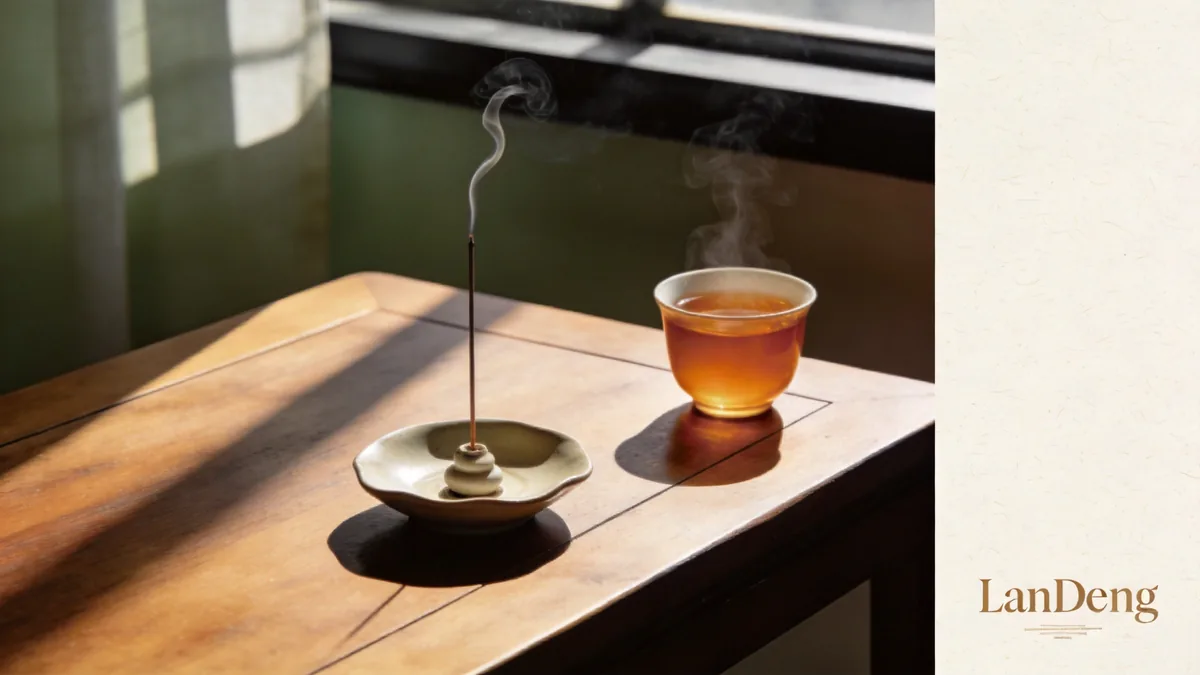
Key takeaway: Incense is most useful as a ritual cue — a consistent scent at a consistent moment that marks a transition: starting work, sitting to meditate, winding down in the evening. The value is in the repetition, not in any special property of the smoke.
Key facts: Because smell is wired to memory and emotion, a repeated scent becomes a learned signal. This is the honest, non-mystical reason incense works as a ritual object.
Key Takeaways
- Incense works as a ritual object through repetition and association, not mysticism.
- Pick one scent per activity — the consistency is what builds the cue.
- A ritual can be simple: light → settle → begin → extinguish.
- This page makes no spiritual-power or health claims.
What a Ritual Actually Is
A ritual is a repeated sequence with a clear beginning and end. Incense fits because:
- Lighting it is the “begin” signal — a deliberate action that starts the practice.
- The scent marks the duration — a stick’s burn can roughly time a session.
- Extinguishing (or letting it finish) is the “end.”
None of this requires a belief system. It is the same mechanism as a familiar song or a specific chair: a repeated cue that tells your attention “now we do this.”
Three Simple Rituals
| Ritual | Scent character | When |
|---|---|---|
| Meditation | Sandalwood, agarwood | A quiet sit |
| Evening unwinding | Soft floral, sandalwood | The wind-down (see the guide) |
| Focus / deep work | Citrus, frankincense | Starting a work block |
The rule is consistency: use the same scent for the same ritual, and the association builds over time.
Why Consistency Matters
Smell is the sense most directly tied to memory and emotion (see how aromatherapy works). When the same scent reliably appears at the same moment, it becomes a learned signal — the smell itself starts to trigger the state. That is the honest, evidence-consistent reason ritual incense “works.”
Common Mistakes
- Changing scents every time. The power is in repetition; pick one scent and stay with it.
- Believing the smoke has special power. It is a cue, not a substance with effects.
- Skipping the “end” step. A ritual needs a clear close, not an unattended smolder.
The Author’s Take
Position: The daily-ritual framing is incense’s most defensible value: a repeated scent at a repeated moment becomes a learned signal.
Reasoning:
- The failure mode is novelty — changing scents every time and wondering why the ritual never “sticks.”
- Pick one scent per activity and keep it; consistency is doing the work, not the smoke.
This is the author’s editorial view and experience — not a verified fact.
Verification Notes
- The “scent as learned cue via repetition” framing is consistent with the established olfactory-memory wiring.
- No spiritual-power, therapeutic, or medical claims are made.
Cluster directory
- Creating a Calming Evening Ritual (Without the Sleep-Aid Nonsense)
- 四般闲事 (Four Leisure Arts): Incense, Tea, Painting, and Flowers
- Incense and Breathwork: Using Scent as a Focus for the Breath
- Incense for Meditation: Formats, Burn Times, and Choosing a Scent
FAQ
Q: Why does incense work as a ritual?
A: Through repetition and association, not through any special property of the smoke. Because smell is the sense most directly wired to memory and emotion, a scent that reliably appears at the same moment each day becomes a learned signal — the smell itself starts to cue the state you want. Lighting the incense marks the beginning, its burn marks the duration, and extinguishing it marks the end. None of this requires a belief system; it is the same mechanism as a familiar song or a specific chair that tells your attention “now we do this.” The consistency of the pairing, not the material, is what makes the ritual effective.
Q: Do I need a belief system to use incense ritually?
A: No. A ritual, in this sense, is just a repeated sequence with a clear beginning and end — lighting, settling in, and finishing. The value comes from the consistency of the cue, not from any doctrine or spiritual framework. You can sit to meditate, start a work block, or wind down in the evening, and the incense simply marks that transition. This is a practical, non-mystical account of why ritual incense works: the repetition builds an association over time, and the scent becomes a signal to your attention. There is no need to adopt any belief system, and this page makes no spiritual-power or health claims.
Q: Which scent should I use for a ritual?
A: Pick one scent you respond to and use it consistently for that one activity, because the consistency — not the specific material — is what builds the cue. Traditional pairings include sandalwood or agarwood for a quiet sit, soft florals or sandalwood for evening unwinding, and citrus or frankincense for focus and deep work. The key rule is to keep the same scent for the same ritual over time, so the association strengthens. If you change scents every time, the cue never “sticks.” For help choosing a material you like, see the scent guide.
Q: How long should a ritual be?
A: Match the length to your activity rather than to any fixed rule. A stick’s burn time — commonly on the order of twenty to sixty minutes depending on the product — can roughly time a short meditation sit, while a coil can mark a longer stretch. The important part is having a clear beginning and end, so the sequence reads as a complete ritual rather than an unattended smolder. Choose a format whose burn roughly matches how long you intend to stay, and let the scent’s finish signal the close. For a more detailed breakdown of session lengths, see incense for meditation.
More Questions Answered
Q: How long does it take to build a scent association?
There is no fixed number of days or sessions. Association builds gradually with consistent repetition, typically over days to weeks of using the same scent for the same activity each time. The mechanism is simple: when the same smell reliably precedes the same state, your brain links the two, and the scent eventually begins to trigger the state on its own. Trying to rush the process by using the incense more often does not help; what matters is the pairing’s consistency, not the frequency or the intensity. Keep one scent per activity, repeat it at the same moment, and let the association form at its own pace.
Q: Can one incense serve multiple rituals?
It can, but it is not ideal. If one scent is used for several different activities, the cue becomes ambiguous — the smell no longer reliably signals any single state. A cleaner approach is one scent per activity: for example, citrus or frankincense for focus and deep work, and a soft floral or sandalwood for evening unwinding. That way each smell maps to its own activity and reliably triggers its own state. If you must reuse a scent, keep the activities as distinct as possible and accept that the association will be slower and weaker than a dedicated pairing.
Q: Do I need a special incense for a ritual?
No. Any scent you respond to consistently will work, because the ritual value comes from repetition, not from a particular material. Sandalwood and agarwood are traditional choices for a quiet sit or meditation, while citrus and frankincense are common for focus and deep work, and soft florals for evening unwinding. What matters more than the material is that you choose something you like and use the same one every time for that activity. There is no required grade, provenance, or “ritual-grade” product; an inexpensive stick used consistently will build the cue just as well as a costly one.
Sources
- Editorial synthesis of established incense-ritual practice.
- Historical references (四般闲事, 香道) drawn from docs/research/chinese-incense-pillar-notes.md (R-003).
- Xiang Cheng (香乘) full text on Wikisource
- Zun Sheng Ba Jian (遵生八箋) full text on Wikisource
Related Resources
Natural next step: build one specific ritual — see a calming evening ritual or incense and breathwork.