Chinese incense knowledge · 香 · 合香 · 香道
LanDeng 澜灯
Field notes on Chinese incense: the materials, the grades they are sold under, the blends they go into, and the evidence behind each statement.
No catalog and no checkout. Where a claim cannot be sourced, the page says so rather than repeating it.
Browse the ingredient referencePositioning
A reference with a paper trail
LanDeng documents Chinese incense for people who have to check a claim rather than repeat it. Each entry answers four questions in order: what the material is, how it is graded, what it is routinely confused with, and which part of the answer rests on a text rather than a measurement.
The range runs from ordinary cedar to protected 崖柏. Grade names are handled as claims with methods attached: 沉水 is a density test, 奇楠 a set of observed characteristics, 老山檀 an age and origin statement that most sellers cannot document.
Browse the ingredient encyclopedia
Content entry points
Start from the question you have
Seven domains, each a different way in. None of them requires reading the others first.
Materials, one entry at a time
150 botanicals — woods, resins, flowers, herbs, spices — with pinyin, origin, grade and the adulterants to check for.
Domain 2Telling real from treated
Grade claims read as claims to test: the density check, the resin lines, the substitutions and how each is caught.
Domain 3Why resin forms at all
Wounding, fungal response and the years between a healthy tree and a bead of agarwood.
Domain 4From fibre to stick
Grinding, sieving, blending, forming, drying, curing — what each step changes in the finished stick.
Domain 5Scent, described honestly
Ten aroma families and a working vocabulary for choosing by atmosphere instead of by label.
Domain 6The texts and the canon
香道, the Four Leisure Arts, the 香谱 manuals, and what the Song–Ming canon actually records.
Domain 7How a 合香 is composed
Chief, minister, assistant, guide: the role each material plays inside a formula, and why order matters.
Explore by entity
The material index
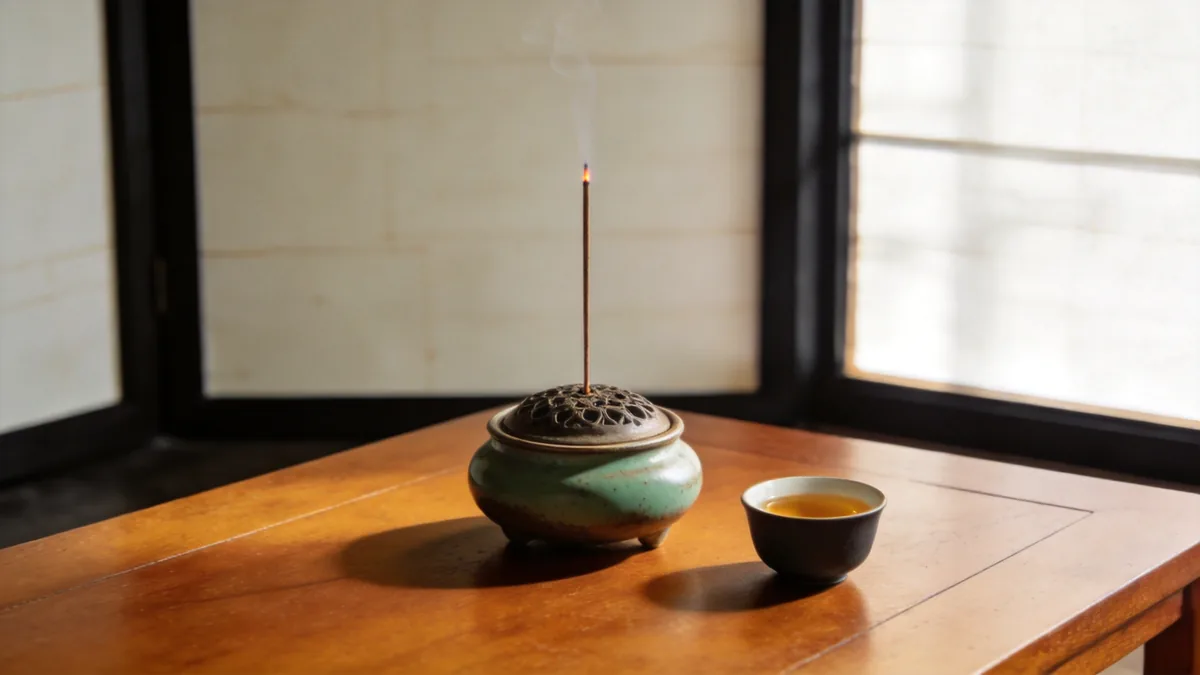
A starter shelf of 24 entries, chosen across the families; the full index runs to 150.
沉香 chénxiāng
Agarwood (沉香): woody, resinous, sweet
Aquilaria spp.
woody · resinous · sweet · complex
ingredient藿香 huòxiāng
Agastache (藿香): minty, herbal, sweet
Agastache rugosa
minty · herbal · sweet · anise-like
ingredient米仔兰 mǐzǎilán
Aglaia (米仔兰): sweet, floral, fruity
Aglaia odorata
sweet · floral · fruity · delicate
ingredient琥珀 hǔpò
Amber (琥珀): resinous, warm, sweet
fossil resin (not botanical)
resinous · warm · sweet · balsamic
ingredient龙涎香 lóngxiánxiāng
Ambergris (龙涎香): marine, sweet, earthy
Physeter macrocephalus (sperm whale) — an animal secretion, not botanical
marine · sweet · earthy · waxy
ingredient砂仁 shārén
Amomum villosum (砂仁): spicy, camphoraceous, warm
Amomum villosum (syn. Wurfbainia villosa)
spicy · camphoraceous · warm · slightly bitter
ingredient白芷 báizhǐ
Angelica (白芷): herbal, aromatic, sweet-bitter
Angelica dahurica
herbal · aromatic · sweet-bitter · slightly spicy
ingredient茴芹 huíqín
Anise (茴芹): sweet, licorice, warm
Pimpinella anisum
sweet · licorice · warm · spicy
ingredient杏仁 xìngrén
Apricot Kernel (杏仁): sweet, nutty, almondy
Prunus armeniaca (apricot kernel)
sweet · nutty · almondy · bitter
ingredient侧柏叶 cèbǎi yè
Arborvitae Leaves (侧柏叶): woody, fresh, green
Platycladus orientalis (the leafy branchlets)
woody · fresh · green · slightly resinous
ingredient郁金 yùjīn
Aromatic Turmeric (郁金): earthy, camphoraceous, warm
Curcuma aromatica
earthy · camphoraceous · warm · slightly bitter
ingredient阿魏 āwèi
Asafoetida (阿魏): pungent, sulfurous, savory
Ferula assa-foetida
pungent · sulfurous · savory · resinous
ingredient细辛 xìxīn
Asarum (细辛): pungent, spicy, rooty
Asarum sieboldii
pungent · spicy · rooty · camphoraceous
ingredient苍术 cāngzhú
Atractylodes (苍术): herbal, woody, pungent
Atractylodes lancea
herbal · woody · pungent · earthy
ingredient竹叶 zhúyè
Bamboo Leaves (竹叶): green, fresh, grassy
Phyllostachys spp. (the leaves)
green · fresh · grassy · slightly sweet
ingredient含笑花 hánxiào huā
Banana Shrub (含笑花): sweet, fruity, floral
Michelia figo (syn. Magnolia figo)
sweet · fruity · floral · banana
ingredient木香花 mùxiānghuā
Banksia Rose (木香花): sweet, floral, honeyed
Rosa banksiae
sweet · floral · honeyed · green
ingredient罗勒 luólè
Basil (罗勒): sweet, green, spicy
Ocimum basilicum
sweet · green · spicy · anise-like
ingredient月桂叶 yuèguì yè
Bay Leaf (月桂叶): herbal, camphoraceous, fresh
Laurus nobilis
herbal · camphoraceous · fresh · slightly sweet
ingredient蜂蜡 fēnglà
Beeswax (蜂蜡): waxy, honeyed, warm
Apis cerana & A. mellifera (bee product) — beeswax
waxy · honeyed · warm · slightly sweet
ingredient安息香 ānxīxiāng
Benzoin (安息香): sweet, vanilla, balsamic
Styrax tonkinensis (Siam); Styrax benzoin / S. paralleloneurus (Sumatra)
sweet · vanilla · balsamic · woody
ingredient佛手柑 fóshǒugān
Bergamot (佛手柑): citrus, floral, fresh
Citrus × bergamia
citrus · floral · fresh · slightly bitter
ingredient白及 báijí
Bletilla (白及): neutral, slightly sweet, earthy
Bletilla striata
neutral · slightly sweet · earthy · starchy
ingredient艾纳香 àinàxiāng
Blumea Balsamifera (艾纳香): camphoraceous, herbal, cooling
Blumea balsamifera
camphoraceous · herbal · cooling · slightly sweet
Editorial standard
How these notes are made
Every entry keeps a visible split between what the classical texts say, what the trade repeats, and what has actually been measured. Sources are named, open questions stay open, and the byline is the editorial team rather than a borrowed expert.
- A traditional claim stays labelled traditional; it is never promoted to fact.
- A number without a method is removed, not rounded into something plausible.
- Entity pages publish machine-readable definitions so search engines and AI systems can quote them accurately.
- No health claims: incense is documented as aroma, craft and culture.