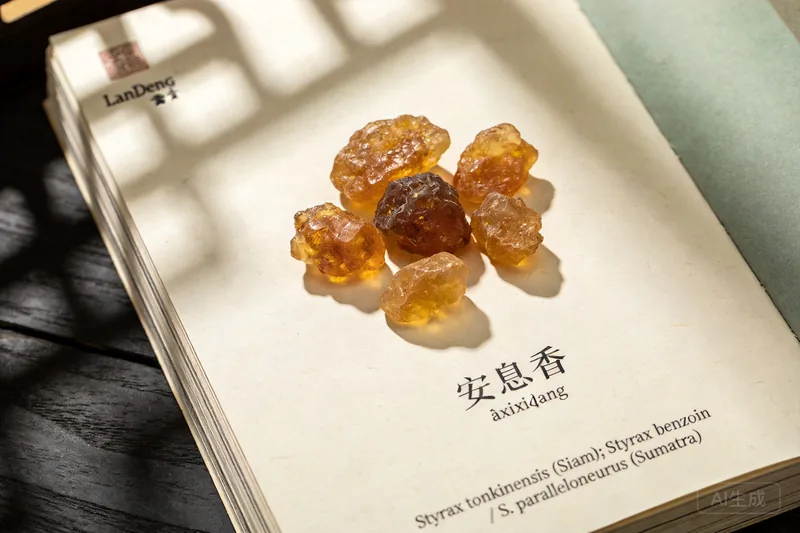
Technical answer: Benzoin — ānxīxiāng (安息香) in Chinese — is a balsamic resin from Styrax trees, prized for a sweet, vanilla-like, balsamic aroma. It is a common ingredient in incense (including church and Chinese incense) and a perfumery fixative.
Key facts
| Chinese | 安息香 (ānxīxiāng) |
| Botanical source | Styrax trees — Siam benzoin (S. tonkinensis), Sumatra benzoin (S. benzoin) |
| What it is | A balsamic resin from tree bark |
| Aroma | Sweet, vanilla, balsamic, woody |
| Traditional role | Incense, perfume fixative |
Aroma profile
Benzoin has a sweet, warm, vanilla-like balsamic scent. It is valued as a fixative — it helps other aromas last — in addition to its own soft sweetness.
The character differs by origin. Siam benzoin reads as the “classic” perfume note: sweet, smooth, vanilla-balsamic with a slightly powdery, woody undertone. Sumatra benzoin is a touch spicier and more resinous. Neither is sharp; both sit at the soft, comforting end of the resin family, which is why benzoin is usually a base or supporting note rather than the star of a blend.
The two kinds (buyer intelligence)
- Siam benzoin (Styrax tonkinensis): sweet, vanilla, balsamic, woody, powdery; used in fragrance and flavoring.
- Sumatra benzoin (Styrax benzoin / S. paralleloneurus): sweet, spicy, vanilla, balsamic; contains cinnamic acid in addition to benzoic acid.
The distinction matters mainly to perfumers and to buyers who want a specific profile: Siam is the reference “vanilla” resin, Sumatra the “spicier” one. For incense use, either works; the label should tell you which you are getting.
A naming disambiguation
“Benzoin” the resin is not the same as the chemical compound “benzoin.” The resin’s main active component is benzoic acid (with cinnamic acid in the Sumatra type). This is a common source of confusion in ingredient lists: a perfume note may list “benzoin” (the resin) while a laboratory catalog lists “benzoin” (the compound). They are different things.
Harvest & processing
Benzoin is collected by making incisions in the bark of Styrax trees; the tree exudes a resin that hardens into tears or blocks over time, which are then scraped off. The resin is a “balsamic” resin — meaning it contains benzoic/cinnamic acids in addition to the resin itself — which is what gives it the distinctive vanilla-sweet character and its fixative power.
In incense & Chinese tradition
- Church incense: benzoin is a staple of Christian incense (Eastern Orthodox, Catholic), often blended with frankincense and myrrh.
- Chinese incense (安息香): benzoin appears as a sweet base in 合香 (blended incense), adding warmth and roundness.
- Japanese and Indian incense also use benzoin as a sweetener/fixative.
- Bakhoor: the Arabic tradition of prepared wood chips sometimes includes benzoin in the fragrance blend.
The Chinese name 安息香 is often glossed as “the fragrance of Parthia (安息),” reflecting the resin’s ancient overland trade origin — a reminder that this material arrived in China as an import, like frankincense and myrrh.
Traditional vs modern evidence
Benzoin has a long traditional use in incense and perfumery. Its resin acids (benzoic acid, cinnamic acid) are the subject of some laboratory research, but this is largely preclinical or industrial (e.g., benzoic acid as a preservative). We describe benzoin’s aromatic and fixative role; we do not make medical claims.
Safety
Incense combustion produces smoke and particulate matter. Burn in a well-ventilated space; avoid inhaling concentrated smoke; keep away from children and pets. Benzoin resin itself is a fragrance/fixative material, not a food or medicine.
FAQ
Is benzoin a wood? No — benzoin is not the wood of the Styrax tree. It is a balsamic resin collected from the tree’s bark. The resin is produced by making incisions in the bark; the tree exudes a sticky substance that hardens into “tears” or blocks, which are then scraped off and sold. Benzoin is classed as a balsamic resin because it contains benzoic acid (and cinnamic acid in the Sumatra type) in addition to the resin itself, which gives it its vanilla-sweet character and fixative power.
Is “benzoin” the same as the chemical? No. The word “benzoin” names two different things that are easily confused. The incense and perfume ingredient is a balsamic resin from Styrax trees, whose main active component is benzoic acid (with cinnamic acid in the Sumatra type). Separately, “benzoin” is also the name of an organic chemical compound used in laboratories. A perfume note listing “benzoin” means the resin; a laboratory catalog listing “benzoin” means the compound. They share a name but are different materials.
What is benzoin used for in incense? Benzoin is used mainly as a sweet base and a fixative in incense. Its warm, vanilla-like, balsamic scent rounds out a blend, softening sharper notes, while its fixative properties help lighter, more volatile aromas persist longer. It is a staple of church incense, where it is often blended with frankincense and myrrh, and it appears in Chinese 合香 as a sweet base, in Japanese and Indian incense as a sweetener, and in the Arabic bakhoor tradition.
People Also Ask (Long-Tail)
What does benzoin smell like? Benzoin has a sweet, warm, vanilla-like scent with a balsamic depth and a slightly powdery, woody undertone. It sits at the soft, comforting end of the resin family — never sharp or astringent — which is why it is usually a base or supporting note rather than the star of a blend. The character differs by origin: Siam benzoin reads as the classic smooth vanilla note, while Sumatra benzoin is a touch spicier and more resinous.
What is benzoin used for in incense? Benzoin serves two roles in incense: a sweet base note and a fixative. Its vanilla-balsamic sweetness rounds out and softens a blend, while its fixative quality helps the lighter notes persist longer on the skin or in the air. It appears across traditions — in church incense (with frankincense and myrrh), in Chinese 合香 as 安息香, in Japanese and Indian incense as a sweetener, and in the Arabic bakhoor tradition where prepared wood chips are fragranced. It is almost always blended rather than burned alone.
Is Siam benzoin different from Sumatra benzoin? Yes. Siam benzoin (Styrax tonkinensis) is the classic, reference vanilla-balsamic resin: sweet, smooth, and powdery, used widely in fragrance and flavoring. Sumatra benzoin (Styrax benzoin or S. paralleloneurus) is a touch spicier and more resinous, and it contains cinnamic acid in addition to benzoic acid. The difference matters mainly to perfumers and buyers who want a specific profile — Siam for the classic vanilla note, Sumatra for the spicier edge. For general incense use either works; the label should say which you are getting.
Is benzoin a wood? No — benzoin is a balsamic resin, not wood. It is collected from the bark of Styrax trees, which are tapped by cutting incisions; the tree exudes a resin that hardens into tears or blocks over time, and these are scraped off. The resin is classed as “balsamic” because it contains benzoic and cinnamic acids alongside the resin itself, which accounts for its vanilla-sweet aroma and fixative power. The wood of the tree is not the aromatic part — the resin is.
How do you burn benzoin resin? Benzoin is burned like other resins, either on a lit charcoal disc or, more gently, on an electric incense heater. For the charcoal method, place the disc on a heatproof surface in sand or ash, light it, and add a small amount of resin once it glows. An electric heater avoids charcoal smoke and lets the resin warm slowly, releasing its vanilla-sweet aroma more cleanly. Benzoin is usually blended with frankincense or myrrh rather than burned alone, and only a small amount is needed.
See also: frankincense and myrrh, its resin relatives, plus the full scent guide.
Sources
Sources: botanical references on Styrax and benzoin resin (Siam vs Sumatra distinction, benzoic/cinnamic acid). This is editorial knowledge content, not medical advice.