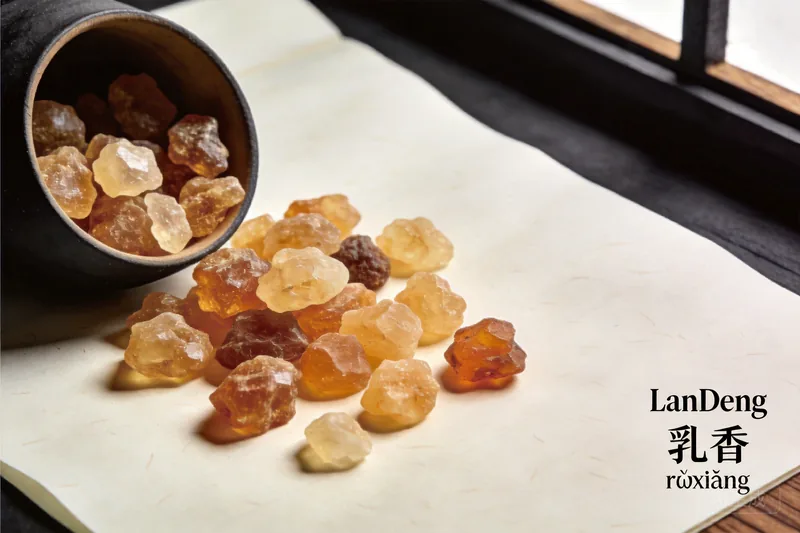
Quick answer: Frankincense — rǔxiāng (乳香, “milk fragrance”) in Chinese — is the aromatic gum-resin of Boswellia trees (family Burseraceae). It is one of the world’s oldest incense resins, used for religious ritual, fumigation, perfume, and traditional medicine.
Key facts
| Chinese | 乳香 (rǔxiāng) — “milk fragrance” |
| Botanical source | Boswellia trees (Burseraceae) — incl. B. sacra, B. serrata, B. carterii |
| What it is | A dried gum-resin (not a wood or flower) |
| Aroma | Resinous, citrus, earthy, creamy |
| Traditional role | Ritual incense, fumigation, perfume |
Aroma profile
Frankincense has a fresh, resinous, slightly citrus (lemony) aroma over a warm, creamy, earthy base. When gently heated it releases a clean, bright scent — distinct from the deep sweetness of woods like agarwood or sandalwood.
In Chinese tradition
- Ritual and religious use: frankincense has been burned in religious and ceremonial contexts for centuries, in China and across the ancient world.
- Incense and fumigation: it is a classic resin incense ingredient, often heated rather than burned directly.
- Traditional materia medica: in traditional Chinese medicine, 乳香 is classically paired with myrrh (没药) and described for “activating blood” (活血) and relieving pain.
Traditional use vs modern evidence
Frankincense resin contains boswellic acids (notably AKBA), which are the subject of modern laboratory research on inflammation. Some preliminary and experimental studies exist.
Important: we treat medicinal claims about frankincense (treating arthritis, asthma, cancer, or other conditions) as traditional use and/or preliminary research, not established clinical fact. Burning frankincense as incense is an aromatic/ritual practice; it is not a medical treatment.
Harvest & processing
Frankincense is harvested by scoring the bark of Boswellia trees; the tree exudes a milky resin that hardens into droplets (“tears”) over days to weeks. The tears are collected by hand and graded by size, color, and clarity — larger, paler, cleaner tears are generally considered higher grade, while dust and mixed fragments are lower grade. The resin is burned whole, ground, or steam-distilled for essential oil.
Species & origins
Not all frankincense is the same — different Boswellia species and regions produce different aroma profiles:
- B. sacra (Oman / Yemen) — the classic, often considered the reference grade.
- B. carterii (Somalia) — common in commerce, clean and citrus.
- B. serrata (India) — earthier and more balsamic.
The species and origin affect the aroma, so a label that names them is more informative than one that just says “frankincense.”
Safety
Incense combustion produces smoke and particulate matter. Burn in a well-ventilated space; avoid inhaling concentrated smoke. Do not consume resin based on traditional-medicine claims without professional guidance.
Frankincense vs myrrh
Both are resins from the same plant family (Burseraceae), but from different genera:
| Frankincense (乳香) | Myrrh (没药) | |
|---|---|---|
| Genus | Boswellia | Commiphora |
| Aroma | Fresh, citrus, creamy | Bitter, balsamic, earthy |
| Character | Bright, clean | Dark, heavy |
| Traditional pairing | Often paired with myrrh | Often paired with frankincense |
FAQ
What is the difference between frankincense and myrrh? Both are resins from the same plant family, Burseraceae, but from different genera. Frankincense comes from Boswellia trees and has a fresh, citrusy, creamy aroma; myrrh comes from Commiphora trees and is bitter, balsamic, and earthy. Frankincense reads bright and clean, while myrrh is darker and heavier. The two are classically paired in Chinese tradition, where 乳香 (frankincense) and 没药 (myrrh) are used together, and in Western religious and perfumery tradition, where the pairing is equally old.
Is frankincense a wood? No — frankincense is a gum-resin, not wood. It is collected from the bark of Boswellia trees, which are scored so the tree exudes a milky resin that hardens into droplets called “tears.” These tears are harvested by hand and graded by size, color, and clarity. The aromatic material is the hardened resin, not the wood of the tree itself. Frankincense is therefore classed as a resin incense ingredient, distinct from aromatic woods like sandalwood or agarwood.
People Also Ask (Long-Tail)
What does frankincense smell like? Frankincense has a fresh, resinous, slightly citrus (lemony) aroma over a warm, creamy, earthy base. When gently heated, it releases a clean, bright scent that is distinct from the deep sweetness of woods like agarwood or sandalwood. The exact character varies by species and origin — B. sacra from Oman and Yemen is classic, B. carterii from Somalia is clean and citrusy, and B. serrata from India is earthier and more balsamic. Overall it reads bright and clean rather than dark and heavy.
How do you burn frankincense resin? Frankincense is traditionally burned on a lit charcoal disc. Place the disc on a heatproof surface in sand or ash, light it until it glows, and add small tears or granules of resin, which will melt and release their aroma. A gentler method is an electric incense heater, which warms the resin slowly without charcoal smoke and gives a cleaner scent. Small tears work best because they heat evenly; large lumps may only partially melt. Avoid inhaling the smoke directly and keep the area ventilated.
Where does frankincense come from? Frankincense comes from Boswellia trees, which grow mainly across the Arabian Peninsula, the Horn of Africa, and parts of India. The resin is tapped by scoring the bark; the tree exudes a milky sap that hardens over days to weeks into droplets called “tears,” which are collected by hand. The main producing regions include Oman and Yemen (B. sacra), Somalia (B. carterii), and India (B. serrata). Origin and species affect the aroma, so a label that names them is more informative.
Is frankincense the same as oud or agarwood? No. Frankincense is a gum-resin from Boswellia trees (family Burseraceae), while oud, also called agarwood, is resin-impregnated Aquilaria wood. They are different materials from different plants with different aromas: frankincense is fresh, citrusy, and resinous, while agarwood is deep, sweet, and woody. The confusion sometimes arises because both are premium aromatic materials, but they are not interchangeable and come from entirely different botanical sources.
Is frankincense a wood? No — frankincense is a dried gum-resin collected from the bark of Boswellia trees, not the wood itself. The tree is scored, and the milky resin that exudes hardens into droplets, or “tears,” which are then harvested by hand. The wood of the tree is not the aromatic part. This distinguishes frankincense from aromatic woods such as sandalwood and agarwood, which are valued for their scented heartwood rather than an exuded resin.
What is the difference between frankincense tears and powder? Tears are the whole dried resin droplets, while powder is the same resin ground fine. They suit different uses. Tears are preferred for gentle heating because they melt and release their aroma slowly, and whole pieces are easier to grade by size and color. Powder is used for blending into incense pastes and sticks, where a uniform, fast-burning form is needed. Both are the same material — Boswellia resin — simply in different physical forms, and neither is inherently higher quality.
Is all frankincense the same? No. Different Boswellia species and origins produce different aroma profiles. B. sacra from Oman and Yemen is the classic, often considered the reference grade; B. carterii from Somalia is common in commerce and clean and citrusy; and B. serrata from India is earthier and more balsamic. The species and region affect the scent, so a label that names them is more informative than one that simply says “frankincense.” For general incense use any good grade works, but the profiles are noticeably different.
See also: the frankincense incense guide and the full scent guide.
Sources
- Boswellia sacra on GBIF
- Boswellia sacra in the CITES species checklist
- Bencao Gangmu (本草綱目) full text on Wikisource
Sources: botanical and pharmacological references on Boswellia. Medicinal claims are treated as traditional/preliminary, not established clinical fact. This is editorial knowledge content, not medical advice.