
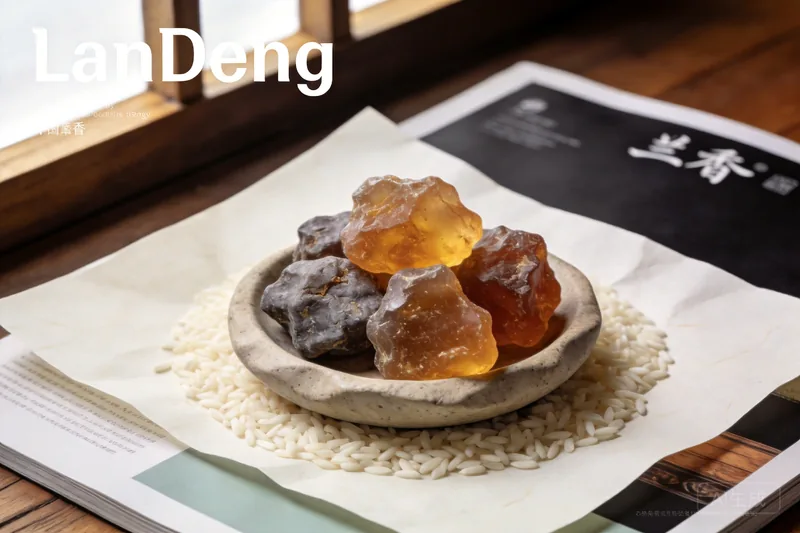
Direct answer: Ambergris (龙涎香, lóngxiánxiāng, “dragon-spittle fragrance”) is a waxy secretion produced in the digestive system of the sperm whale (Physeter macrocephalus). It is prized as a fixative in perfumery and traditional incense, with a marine, sweet, earthy scent. Unlike most incense ingredients, it is animal-derived, not botanical.
Key facts
| Chinese | 龙涎香 (lóngxiánxiāng) |
| Source | Sperm whale (Physeter macrocephalus) — an animal secretion |
| What it is | A waxy, fatty secretion (not a plant, wood, or resin) |
| Aroma | Marine, sweet, earthy, waxy (aged) |
| Traditional role | Perfume fixative, traditional incense, materia medica |
Aroma profile
Direct answer: Fresh ambergris has a marine, slightly fecal character; as it ages and oxidizes it develops the prized sweet, earthy, waxy-amber scent that made it a legendary fixative. It is valued less as a loud note than for its ability to anchor and extend other aromas.
Fresh ambergris has a marine, slightly fecal character; as it ages and oxidizes, it develops the prized sweet, earthy, waxy-amber scent that made it a legendary perfumery fixative. It is valued less as a loud note than for its ability to anchor and extend other aromas.
The aging process is the whole story of its aroma: the raw secretion, expelled at sea, is weathered by salt water, sun, and oxygen for months or years, and it is this slow oxidation — chiefly of the triterpene ambergris alcohol ambrein into compounds like ambrein’s oxidized relatives and the odor-bearing ambrox — that converts a marine, animalic, even fecal substance into the smooth, sweet, earthy amber note perfumers prize. In other words, ambergris is a material that is made by time and sea, not simply harvested.
The “not botanical” point (read this)
Direct answer: Ambergris is the one ingredient in this encyclopedia that is not a plant. It is an animal product from the CITES-listed sperm whale, so trade is restricted and most “ambergris” on the market today is synthetic — ambroxide/ambreine and related compounds — not the natural secretion.
Ambergris is the one ingredient in this encyclopedia that is not a plant. It is an animal product, which matters for two reasons:
- Sourcing — ambergris trade is restricted (the sperm whale is CITES-listed), and most “ambergris” on the market today is synthetic (ambroxide / ambreine and related compounds), not the natural secretion.
- Category — a “botanical incense” that includes ambergris is stretching its own definition; most contemporary incense uses the synthetic fixative instead.
This is a sourcing and category fact, not a health claim.
Chinese name and terminology
Direct answer: The Chinese name 龙涎香 means “dragon-spittle fragrance” (龙 dragon, 涎 saliva, 香 fragrance) — a name born of a classical misunderstanding that located the sea-found wax in dragon drool. The name is folk etymology, not science, and it now names a scent family largely carried by synthetics.
The name 龙涎香 (lóngxiánxiāng) is one of the most evocative in the aromatic canon, and it is a folk etymology: 龙 (lóng, dragon), 涎 (xián, saliva/spittle), 香 (xiāng, fragrance) — “dragon-spittle fragrance.” Classical Chinese accounts imagined the sea-found wax as the dried saliva of dragons, a poetic guess that predates the modern identification of ambergris as a sperm-whale product. The name is worth knowing precisely because it is not the science: it records how a mysterious, floating, sea-found material was explained before whale biology was understood.
The same material travels under the Arabic-derived English “ambergris” (from ‘anbar), and its scent is now carried by the synthetic ambroxide (ambroxan) and ambreine, which reproduce the amber character without the whale. As with musk, the word has outlived the animal: “ambergris” or “amber” on a modern label usually means the synthetic.
The “marine origin” positioning (read this)
Direct answer: Ambergris is unique among incense materials as a marine, ocean-derived product — it is not harvested from a cultivated or wild plant, but found floating at sea or washed ashore. This “found, not farmed” supply makes it structurally different from every botanical ingredient, and its ocean origin is part of its identity, not a marketing gloss.
Ambergris occupies a category of one in this encyclopedia: it is a marine, animal-derived material in a canon otherwise built on woods, resins, flowers, and herbs. Three things follow from its ocean origin:
- Found, not farmed. Ambergris is not harvested from a cultivated source; it is expelled by sperm whales and recovered after floating at sea or washing ashore. Supply is therefore accidental — a function of ocean currents and beachcombing, not agriculture or wild harvest.
- Aging is the processing. Unlike a wood that is cut and cured, ambergris’s transformation is environmental: months or years of salt water, sun, and oxidation are what convert the raw secretion into the valued amber note.
- The ocean is the provenance. Where a buyer asks “which region” of an agarwood, for ambergris the meaningful provenance is sea-weathering — how long it floated, how it aged — not a specific farm or forest.
This marine, found-not-farmed identity is what makes ambergris genuinely distinct: it is the one material whose supply chain is the sea itself.
In Chinese tradition
- Traditional incense: 龙涎香 appears in classical Chinese incense and materia medica as a rare, precious fixative.
- Perfumery: ambergris (and, today, its synthetic replacements) is a legendary fixative that extends and rounds a fragrance.
- Rarity: natural ambergris is scarce, which is why it has always been associated with luxury and, today, is largely replaced by synthetics.
Traditional use vs modern evidence
Direct answer: Ambergris appears in traditional Chinese medicine with various described uses. We treat these as traditional, not established clinical fact, and make no medical claims. The documented facts are the sperm-whale source, the marine origin, the aging/oxidation chemistry, and the fixative role.
- Traditional Use — 龙涎香 appears in classical Chinese materia medica with described uses. Traditional materia-medica language, not modern clinical evidence.
- Historical Record — ambergris is documented in classical Chinese incense and materia medica as a rare, precious fixative.
- Scientific Evidence — the source identity (Physeter macrocephalus), the marine origin, and the ambrein→ambrox oxidation chemistry are established. We present no clinical or medical efficacy claims.
Ambergris appears in traditional Chinese medicine with various described uses. We treat these as traditional, not established clinical fact, and make no medical claims. This page describes its aromatic and fixative role only.
Ambergris vs musk (both animal fixatives)
Direct answer: Ambergris and musk are both legendary animal fixatives, but ambergris is a sperm whale’s marine digestive secretion with a sweet, earthy, waxy-amber scent, while musk is a musk deer’s glandular secretion with a warm, sweet, skin-like scent. Both are CITES-restricted and both are now largely synthetic.
| Ambergris (龙涎香) | Musk (麝香) | |
|---|---|---|
| Source | Sperm whale (Physeter macrocephalus) digestive secretion | Musk deer (Moschus) pod secretion |
| Origin | Marine — found at sea / washed ashore | Terrestrial — deer of Asia’s mountains |
| Aroma | Sweet, earthy, waxy-amber (aged) | Warm, sweet, skin-like, musky |
| Chemistry | Ambrein and oxidation products (ambrox) | Muscone and macrocyclic ketones |
| Status today | Largely synthetic (ambroxide, ambreine) | Largely synthetic (musk ketone, galaxolide) |
The two are complements, not substitutes: ambergris contributes marine-amber sweetness, musk contributes animalic-skin warmth. Both anchor a blend from below, and both are now, in practice, synthetic categories. See musk.
Common forms
Direct answer: Natural ambergris is found as floating or beached lumps graded by age and oxidation; it reaches perfumery as a tincture or extract. In modern practice “ambergris” in incense is a synthetic — ambroxide or ambreine — a different material entirely.
| Form | Description |
|---|---|
| Raw ambergris lump | The found secretion, graded by age, oxidation, and color |
| Ambergris tincture | Dissolved in alcohol for perfumery |
| Ambergris absolute | Solvent-extracted concentrate |
| Synthetic ambroxide / ambreine | The modern laboratory replacements |
The first three are natural marine forms; the last is the modern material that dominates today’s market. For a contemporary buyer, “ambergris” almost always means the synthetic, and the distinction between natural and synthetic is the decisive sourcing question.
Conservation and sourcing notes
Direct answer: Ambergris trade is restricted because the sperm whale is CITES-listed, and most “ambergris” on the market is synthetic. For buyers, the practical point is provenance — natural ambergris is rare and legally sensitive, so a credible supplier should state plainly whether a material is natural or synthetic.
- Natural ambergris is a sperm-whale product from a CITES-listed species; its trade is restricted, and this encyclopedia documents it as historical and connoisseurship context, not as a material to source.
- Most “ambergris” in contemporary fragrance and incense is synthetic (ambroxide / ambreine), which reproduces the amber fixative character without the animal.
- A credible supplier should be able to say whether a material is natural ambergris or synthetic — the label “ambergris” or “amber” alone is not a provenance statement.
The responsible modern framing mirrors musk: because the animal source is protected, the synthetic is the consistent, legal, ethical choice, and the professional question is which material — not whether the name appears on the label. See natural vs synthetic incense.
Safety
Incense combustion produces smoke and particulate matter; burn in a well-ventilated space and avoid inhaling concentrated smoke. Note that most “ambergris” in incense is synthetic, which is a sourcing matter, not a safety claim. This is editorial knowledge content, not medical advice. See our safety guide.
Our Industry View
Direct answer: Ambergris’s defining commercial fact is that it is a found, not farmed, material — its supply is accidental, sea-driven, and un-scaleable. That is precisely why the synthetic (ambroxide/ambreine) became the industry standard, and why “ambergris” is now a scent target, not a material, for anyone manufacturing at commercial volume.
From a manufacturing perspective, ambergris is the clearest demonstration in this encyclopedia of why certain materials get replaced by synthetics — and why that is not a loss but a category shift. Three points follow:
- Accidental supply cannot scale. Ambergris is not cultivated; it is found. You cannot plant it, grow it, or harvest it on a schedule. A manufacturer building a repeatable product on an ingredient whose supply depends on a whale, an ocean current, and a beachcomber is building on sand. This is the structural reason the synthetic won: ambroxide is made to order, batch after batch, at consistent cost and quality.
- Aging is the value, and aging is time. The prized ambergris note is an oxidation product, produced by months or years of sea weathering. The synthetic skips the wait by delivering the oxidized character directly. For a production line, “skipping the wait” is not a shortcut; it is the whole point.
- The name is now a scent target. In commercial incense and fragrance, “ambergris” describes a marine-amber, warm, slightly sweet register — a specification, not a whale product. The professional framing is to confirm which synthetic (or, rarely, which natural grade) achieves that register, rather than to assume the word means the animal.
In our view, the commercial reality of ambergris is a synthetic amber fixative with a historical marine name, and the professional move is to be explicit about that substitution — because the consistency, legality, and ethics all sit on the synthetic side.
Summary
Ambergris (龙涎香, “dragon-spittle fragrance”) is the aged, sea-weathered digestive secretion of the sperm whale (Physeter macrocephalus), the one marine, animal-derived material in a canon otherwise built on plants. Its value is an oxidation story — salt water, sun, and time convert a raw marine secretion into the sweet, earthy, waxy-amber fixative perfumers prize — and its supply is accidental, found rather than farmed. Because the sperm whale is CITES-listed, most “ambergris” today is synthetic ambroxide or ambreine; the name now denotes a scent target, not the animal.
FAQ
Is ambergris a plant? No — ambergris is not botanical. It is a waxy secretion produced in the digestive system of the sperm whale (Physeter macrocephalus). This makes it unique among the ingredients in this encyclopedia: everything else comes from plants, woods, or resins, while ambergris is animal-derived. The distinction matters for sourcing and for labeling — a “botanical incense” that includes natural ambergris is stretching its own definition, and most contemporary products use a synthetic substitute instead.
Is ambergris still used today? Natural ambergris is still used, but rarely. It is scarce — produced by only a small fraction of sperm whales and usually found washed ashore — and the sperm whale is CITES-listed, which restricts trade. As a result, most “ambergris” in modern fragrance and incense is a synthetic substitute such as ambroxide or ambreine, which reproduces the fixative and amber character without the animal source. When a label says “ambergris,” it usually means the synthetic compound rather than the natural secretion.
What does ambergris smell like? Fresh ambergris has a marine, slightly animalic — even fecal — character. As it ages and oxidizes, exposed to air and seawater, it develops the prized sweet, earthy, waxy-amber scent that made it a legendary perfumery fixative. The value lies less in a loud single note than in its ability to anchor and extend other aromas, adding warmth and depth to a blend. The aged, oxidized material is considered far superior to the fresh secretion.
What is the synthetic substitute for ambergris? The main synthetic substitutes are ambroxide (also called ambroxan) and ambreine, compounds that reproduce ambergris’s fixative and warm amber character without any animal source. These synthetics are inexpensive, consistent, and legal to trade, which is why they dominate modern perfumery and incense. They are widely described as “ambergris” or “amber” notes. Chemically they are related to ambrein, the key odor-bearing compound in natural ambergris, but they are produced in the laboratory rather than harvested from whales.
Why is ambergris so expensive? Natural ambergris is expensive because it is rare and difficult to obtain. Only a small fraction of sperm whales produce it, and the material is usually found washed ashore or floating at sea rather than harvested deliberately, making supply unpredictable. Trade is restricted because the sperm whale is CITES-listed. Scarcity, combined with the fixative’s unmatched ability to extend a fragrance, drives the price. Genuine aged ambergris can command very high prices, while synthetic substitutes are inexpensive.
Why is it called “dragon-spittle fragrance”? The Chinese name 龙涎香 (lóngxiánxiāng) is a folk etymology: 龙 (dragon), 涎 (saliva), 香 (fragrance). Classical accounts imagined the mysterious sea-found wax as the dried saliva of dragons, a poetic explanation that predates the modern identification of ambergris as a sperm-whale product. The name records how the material was explained before whale biology was understood — it is etymology, not science.
How is ambergris different from musk? Both are animal fixatives, but from different animals, origins, and chemistries. Ambergris is the sperm whale’s marine digestive secretion, with a sweet, earthy, waxy-amber scent produced by sea-aging; musk is the musk deer’s glandular secretion, with a warm, sweet, skin-like scent. Ambergris is marine and “found not farmed,” while musk is terrestrial. Both are CITES-restricted and both are now largely synthetic. See musk.
See also: musk, sandalwood, agarwood, civet, natural vs synthetic incense, onycha and the full scent guide.
Evidence & Sources
Botanical identity
Source: Physeter macrocephalus (sperm whale) on GBIF · Physeter macrocephalus in the CITES species checklist — ambergris is an animal secretion, not botanical. Evidence type: Established.
Traditional Chinese use
Source: 本草綱目 (Bencao Gangmu) full text on Wikisource and this page’s record that 龙涎香 appears in classical Chinese incense and materia medica as a rare, precious fixative. Evidence type: Historically documented — traditional materia-medica language, not modern clinical evidence.
Commercial grading
Source: the natural-vs-synthetic market note (ambroxide / ambreine) and the sperm whale’s CITES trade listing. Evidence type: Trade terminology.
Authenticity / adulteration
Source: most “ambergris” on the market today is synthetic, not the natural secretion — a sourcing point, not a health claim. Evidence type: Practical screening.
Safety
Source: incense combustion produces smoke and particulate matter; burn in a well-ventilated space. Evidence type: Established.
Evidence status
| Layer | Status |
|---|---|
| Botanical identity | Established |
| Traditional use | Historically documented |
| Commercial grading | Trade terminology |
| Authenticity test | Practical screening |
| Health claims | Not established |
Sources
- Physeter macrocephalus (sperm whale) on GBIF
- Physeter macrocephalus in the CITES species checklist
- Bencao Gangmu (本草綱目) full text on Wikisource
Sources: references on ambergris (sperm whale secretion, aging/oxidation, fixative role, CITES trade status, and synthetic substitutes ambroxide/ambreine). Medicinal uses are treated as traditional, not established clinical fact. This is editorial knowledge content, not medical advice.