Data summary: 四般闲事 (“four leisurely arts”) is the Song-dynasty ideal of cultivated leisure — 烧香 (burning incense), 点茶 (whisking tea), 挂画 (hanging paintings), and 插花 (arranging flowers). The phrase comes from 吴自牧’s 梦粱录 (Meng Liang Lu): “烧香点茶,挂画插花,四般闲事,不宜累家” — four leisurely arts, not to be burdened by household cares.
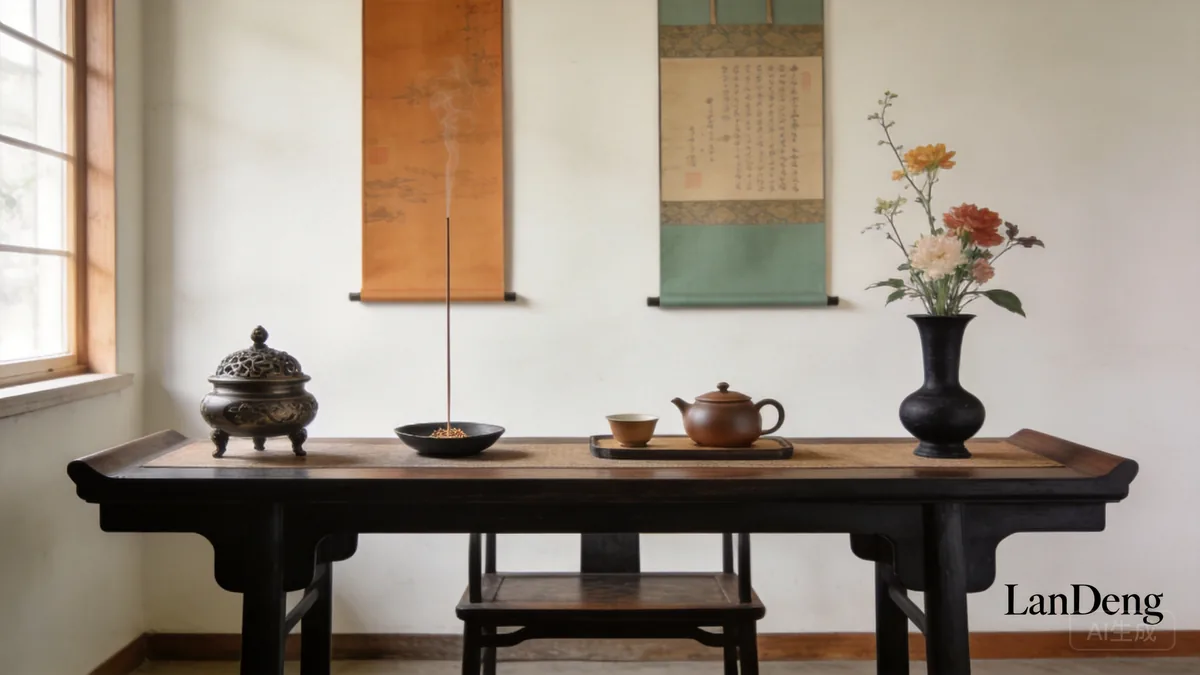
Key facts: Incense was one of four — it was not practiced in isolation, but as part of a coordinated aesthetic of the scholar’s life. This is a cultural-history page, not a wellness or therapeutic claim.
The Four, Briefly
| Art | Chinese | What it involves |
|---|---|---|
| Burning incense | 烧香 | Preparing and appreciating incense — from simple sticks to formal 隔火焚香 |
| Whisking tea | 点茶 | Whisked powdered tea (the ancestor of Japanese matcha) |
| Hanging paintings | 挂画 | Displaying and appreciating scroll paintings |
| Arranging flowers | 插花 | Composing cut flowers in vases |
The Phrase and Its Source
The four arts are commonly quoted from 吴自牧’s 梦粱录 (a Song-dynasty memoir of Hangzhou life): “烧香点茶,挂画插花,四般闲事,不宜累家.”
The last clause is the key — “不宜累家” — the arts should not become a burden on the household. They are “闲” (leisure) precisely because they are not productive, not status-seeking, and not labor. This is the opposite of how incense is often marketed today (as a wellness or productivity tool).
Chinese 香道 vs Japanese Kōdō
The incense of the 四般闲事 is the Chinese tradition — informal, scholarly, personal. The Japanese kōdō (香道) descends from Chinese incense culture (transmitted via Buddhism and the Tang/Song exchange) but became a formalized ritual art with codified games (组香, such as 源氏香), a fixed vocabulary (六国五味 — “six countries, five tastes”), and graded schools.
| Aspect | Chinese 香 tradition | Japanese kōdō |
|---|---|---|
| Frame | One of four leisure arts | A standalone formalized art |
| Style | Personal, scholarly, informal | Ritualized, codified, school-based |
| Vocabulary | 香谱 recipes, 合香 blending | 六国五味, 组香 games |
| Materials | Agarwood, sandalwood, 合香 blends | Centered on agarwood (奇楠 = “kyara”) |
This is a cultural-historical comparison, not a ranking — neither is “better,” they are different developments of a shared root.
Why Incense Sits in This Company
The point of grouping incense with tea, painting, and flowers is that they are all arts of attention — practices that slow the practitioner down and sharpen perception. Incense is the olfactory member of the set; it trains the same quality of attention the others train through taste, sight, and touch.
For how incense is actually used in a mindful context today, see incense for meditation and incense in daily ritual.
The Author’s Take
Position: The 四般闲事 frame is the best correction to the modern “productivity incense” narrative — because the whole point of 闲 (leisure) was that it was not productive.
Reasoning:
- Marketing sells incense as a focus/work tool; the Song ideal placed it among arts whose only purpose was attention and pleasure.
- “不宜累家” is a better instruction than any “best incense for X” list: if the practice becomes a burden, it has failed its own ideal.
This is the author’s editorial view — not a verified fact.
Verification Notes
- The “烧香点茶,挂画插花,四般闲事,不宜累家” attribution is to 吴自牧《梦粱录》, a Song-dynasty source; it is a cultural-historical record, not a therapeutic claim.
- The Chinese-vs-Japanese comparison is a cultural observation; kōdō details (六国五味, 源氏香) are standard references.
FAQ
Q: What are the four leisure arts?
烧香 (burning incense), 点茶 (whisking tea), 挂画 (hanging paintings), and 插花 (arranging flowers) — the Song-dynasty ideal of cultivated leisure. The phrase treats these four as a coordinated aesthetic of the scholar’s life rather than isolated hobbies. Incense was one of four, not practiced alone: the point of the grouping is that these are arts of attention and pleasure, each training perception through a different sense.
Q: Where does the phrase come from?
吴自牧’s《梦粱录》(Meng Liang Lu), a Song-dynasty memoir of daily life in the capital Hangzhou. The passage reads: “烧香点茶,挂画插花,四般闲事,不宜累家” — burning incense, whisking tea, hanging paintings, arranging flowers: four leisurely arts, not to be burdened by household cares. This single line is the canonical source for the phrase and for incense’s place among the refined pastimes of the era. Because it is a cultural-historical record rather than a medical or ritual text, it is cited here as evidence of how incense was grouped with the other cultivated arts, not as a health or efficacy claim.
Q: Is Chinese incense the same as Japanese kōdō?
They share a root, but developed differently. Chinese incense is one of four informal leisure arts — personal, scholarly, and loosely structured. Japanese kōdō descends from the same tradition (transmitted via Buddhism and the Tang/Song exchange) but became a standalone, formalized ritual art with codified games (组香, such as 源氏香), a fixed vocabulary (六国五味), and graded schools. The comparison is historical and cultural, not a ranking.
Q: What does “不宜累家” mean?
“Not to be a burden on the household.” The clause is the key to the whole phrase: these four arts are “闲” (leisure) precisely because they are not productive, not status-seeking, and not labor. They should remain pleasurable and unhurried rather than become obligations. It is a gentle corrective to how incense is often marketed today — as a productivity or wellness tool — since the Song ideal placed these arts firmly outside work and duty.
Sources
- 吴自牧《梦粱录》— the source of the 四般闲事 phrase (cultural history).
- Meng Liang Lu (夢粱錄) full text on Wikisource
- Bencao Gangmu (本草綱目) on ctext.org
- Standard references on Japanese kōdō (六国五味, 组香/源氏香).
Related Resources
Natural next step: see the Japanese development in Japanese Incense (Kōdō).