At a glance: Chinese incense culture spans roughly three millennia, from aromatic offerings in the Shang dynasty (c. 1600–1046 BCE) to a refined aesthetic practice in the Song dynasty (960–1279), followed by codification in the Ming, decline through the Qing and 20th century, and a revival from the 2000s onward.
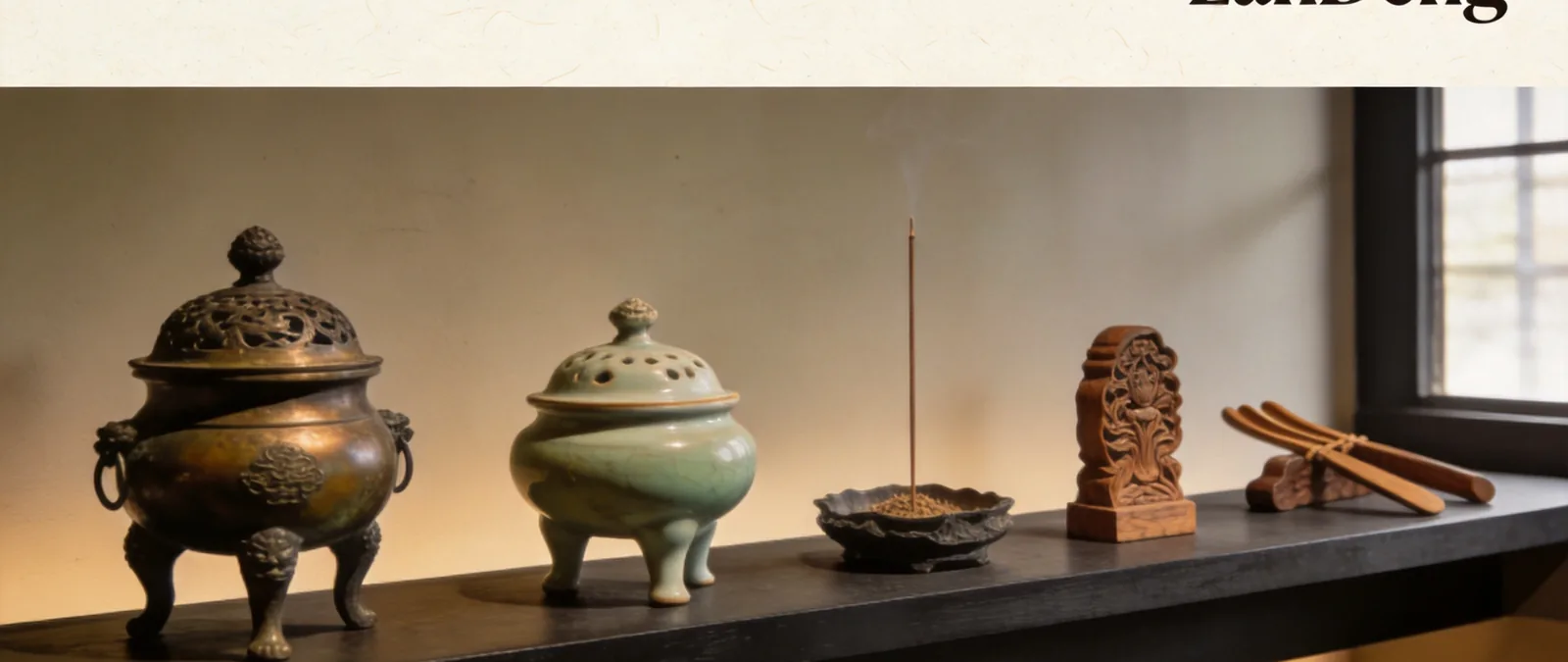
Key facts: The first clear written mark is the character 香 on Shang oracle bones. Incense shifted from ritual offering to aesthetic enjoyment around the Han dynasty with the 博山炉 (Boshan censer). The Song dynasty is the cultural peak — the era of 四般闲事, 隔火焚香, and the great 香谱 manuals.
Key Takeaways
- Incense began as ritual offering (Shang–Han) and became an aesthetic art by the Song dynasty.
- The Song dynasty is the peak — the source of the 四般闲事 “Four Leisure Arts” and the low-smoke 隔火焚香 technique.
- The Ming dynasty perfected the everyday stick (线香) and produced the celebrated 宣德炉 (Xuande) censers.
- The tradition nearly died out in the 20th century (Western perfume, cultural upheaval) and has been reviving since the 2000s.
- Dates are given conservatively; “3,000 years” is the defensible span, not “5,000 years.”
A Timeline at a Glance
| Period | Approx. dates | Marker |
|---|---|---|
| Shang | 1600–1046 BCE | 香 appears on oracle bones; aromatic plants burned as offerings |
| Han | 206 BCE–220 CE | 博山炉 Boshan censer — incense moves from ritual to aesthetics |
| Wei–Jin & Northern/Southern | 220–589 | Buddhism + Silk Road/maritime trade import agarwood, sandalwood, borneol, frankincense, myrrh, clove |
| Sui–Tang | 581–907 | First golden age; court luxury; 合香 (blended incense) matures |
| Song | 960–1279 | Peak: 四般闲事, 隔火焚香, 篆香, 香谱 manuals |
| Ming | 1368–1644 | Codification; 宣德炉 censers; 线香 (stick incense) perfected |
| Qing → 20th c. | 1644–1912 → | Decline: sumptuary laws, Western perfume, Cultural Revolution (“four olds”) |
| 2000s– | — | Modern revival: studios, museums, and DTC brands |
Shang to Han: From Offering to Aesthetic
The earliest written evidence is the character 香 in Shang oracle-bone inscriptions, tied to aromatic offerings. In this early phase, incense was primarily ritual and sacrificial — fragrant plants were burned as part of offerings.
The Han dynasty marks the pivot. The 博山炉 (Bóshān lú, “Boshan censer”), a mountain-shaped burner, appears — a signal that incense had moved from pure ritual into aesthetic and courtly enjoyment. Trade along the Silk Road (and later maritime routes) brought new materials — agarwood, sandalwood, frankincense, myrrh, borneol, clove — which expanded the palette dramatically during the Wei–Jin period alongside the spread of Buddhism.
Song: The Cultural Peak
The Song dynasty (960–1279) is the single most important era for understanding Chinese incense. Three things crystallized:
- 四般闲事 (the Four Leisure Arts). Wu Zimu’s 梦粱录 lists 烧香 (incense) alongside 点茶 (tea), 挂画 (hanging scrolls), and 插花 (flower arranging) as the four refined pastimes — “不宜累家” (“not to be treated as chores”).
- 隔火焚香 (indirect-fire incense). Instead of burning material directly, practitioners buried hot charcoal in ash, placed a thin mica or silver plate above, and rested the fragrant wood on top — releasing pure aroma with little smoke. This technique is the recognized ancestor of Japanese kōdō.
- 香谱 (incense manuals). Works like 陈氏香谱 (Chen’s Incense Manual), 洪芻香谱, and the encyclopedic 香乘 by Zhou Jiazhou codified formulas and lore — the world’s most complete ancient incense literature, still largely untranslated.
The Song also developed 篆香 (seal incense): powder pressed into a patterned stamp that burned along a timed path, doubling as a timekeeping device.
Ming and Qing: Codification, Then Decline
The Ming dynasty perfected the everyday stick (线香) and produced the renowned 宣德炉 (Xuande-period) censers — a high point for incense vessels.
From the Qing dynasty onward, the tradition gradually contracted: sumptuary restrictions, the rise of Western perfume, and — in the 20th century — the Cultural Revolution’s targeting of “four olds” (old customs) pushed classical incense practice to near-extinction. For much of the 20th century it survived mainly in temples and marginal studios.
The Modern Revival
From roughly the 2000s, classical Chinese incense has revived: specialist studios and 香道 practitioners have reappeared, museums and collectors have re-centered the material culture, and a new generation of brands has begun translating the tradition for a global audience. This revival is the context in which most contemporary Chinese-incense DTC brands — including LanDeng — operate.
Common Mistakes
- Repeating “5,000 years of history.” The defensible span is ~3,000 years, from Shang oracle-bone 香 to today.
- Saying incense “died out.” It contracted severely but was preserved in temples and specialist circles; it did not vanish.
- Attributing the refined low-smoke technique to Japan. 隔火焚香 is a Song-dynasty Chinese technique that Japan later systematized as kōdō.
The Author’s Take
Position: My strong view is that the English web gets the origin of refined incense wrong — it credits Japan when the 隔火焚香 technique is Song-dynasty Chinese.
Reasoning:
- This is not nationalist nitpicking: the 香谱 manuals that codified the practice remain largely untranslated — an information gap worth closing.
- The honest “~3,000 years, not 5,000” is a credibility signal: a source that resists inflation is one you can trust on the rest.
This is the author’s editorial view and experience — not a verified fact.
Verification Notes
- Historical dates follow standard dynastic periodization and are cross-referenced across the sources below.
- The “Four Leisure Arts” attribution to Wu Zimu’s 梦粱录 is a direct textual citation.
- The Song→Japan transmission is stated as a high-confidence historical interpretation (multiple secondary sources), not a single primary-source “fact.”
- No health or therapeutic claims are made anywhere in this article.
FAQ
Q: How old is Chinese incense culture?
Conservatively about 3,000 years, measured from the appearance of the character 香 on Shang-dynasty (c. 1600–1046 BCE) oracle bones to the present day. In that earliest phase incense was primarily ritual and sacrificial — fragrant plants burned as offerings. The aesthetic tradition is clearly visible from the Han dynasty, when the Boshan censer signaled a shift from pure ritual toward refined enjoyment. LanDeng states the ~3,000-year span deliberately rather than the common inflated “5,000 years.”
Q: When was the golden age of Chinese incense?
The Song dynasty (960–1279) is the cultural peak. Three things crystallized there: the Four Leisure Arts (四般闲事), which placed incense alongside tea, painting, and flowers; the low-smoke indirect-fire technique (隔火焚香), ancestor of Japanese kōdō; and the great incense manuals (香谱), which codified formulas and lore. The Song also developed seal incense (篆香). Earlier Tang was a first golden age, but the Song is where the refined aesthetic reached its height.
Q: Did Chinese incense become Japanese incense?
They share a root but are not the same. Japanese kōdō descended from the Song-dynasty Chinese indirect-fire technique (隔火焚香), transmitted along with tea and Buddhism. Chinese culture is the source; Japan systematized, formalized, and preserved the practice as a standalone ritual art with codified games and vocabulary. Chinese incense, by contrast, remained one of four informal leisure arts. The honest framing is shared origin, divergent development.
Q: Why did Chinese incense decline?
Several forces contracted the tradition. Sumptuary restrictions and the rise of Western perfume reduced demand through the Qing; then 20th-century cultural upheaval — most notably the Cultural Revolution’s targeting of “four olds” (old customs) — pushed classical incense practice to near-extinction. For much of the 20th century it survived mainly in temples and specialist studios. From roughly the 2000s it has revived through studios, museums, collectors, and new brands.
More Questions Answered
Q: What is a Boshan censer (博山炉)?
A mountain-shaped incense burner from the Han dynasty (206 BCE–220 CE), named after the mythical Mount Bo. Its appearance marks a turning point: incense began to move from pure ritual offering into aesthetic and courtly enjoyment. The Boshan censer is often taken as the first clear sign of incense as a refined pastime rather than only a sacrifice — the material evidence that burning fragrant material had become an art as well as a rite.
Q: What is seal incense (篆香)?
A Song-dynasty practice in which incense powder is pressed into a patterned stamp and then lit, so the trail burns along a fixed, predictable path. It doubled as both a visual art and a timekeeping device: the powder burned at a known rate, so the trail’s progress marked the passage of time. Seal incense is one of the refined “low-smoke, high-craft” forms the Song developed, distinct from sticks and coils.
Q: What is the Xuande censer (宣德炉)?
A celebrated bronze censer from the Ming dynasty’s Xuande period (1426–1435). Xuande-period censers are among the most famous incense vessels in Chinese material culture, prized for their metalwork and their association with the imperial court. They represent the Ming as a high point for incense vessels — the same era that perfected the everyday stick (线香) — and they remain a reference point for collectors of classical Chinese incense objects.
Q: When did Chinese incense reach Japan?
Incense arrived in Japan in the 6th century CE with the spread of Buddhism, carrying both the materials (agarwood, sandalwood) and the ritual of burning them as offerings. The refined Song-dynasty indirect-fire technique (隔火焚香) followed later and became the basis of Japanese kōdō, which formalized the practice. So the flow was not one event but a series: materials first, then the refined technique. See Japanese incense & kōdō.
Q: What are the 香谱 (xiāng pǔ) incense manuals?
The body of classical Chinese incense literature — works such as 陈氏香谱 (Chen’s Incense Manual), 洪芻香谱, and the encyclopedic 香乘 compiled by Zhou Jiazhou — which recorded formulas, materials, and lore. They are widely considered the world’s most complete ancient incense literature and remain largely untranslated into English. This untranslated status is itself part of why the English-language web often gets Chinese incense history wrong, a gap LanDeng works against.
Sources
- 吴自牧《梦粱录》 — primary source for the Four Leisure Arts.
- 光明日报 (Guangming Daily) — Song 香文化 and 合香 features.
- 陈氏香谱 / 香乘 — canonical incense manuals (historical).
- China Daily / Feuerle Collection — modern revival context.
- Meng Liang Lu (夢粱錄) full text on Wikisource
- Xiang Cheng (香乘) full text on Wikisource
- Bencao Gangmu (本草綱目) on ctext.org
- Research synthesis: docs/research/chinese-incense-pillar-notes.md (R-003).
Related Resources
Natural next step: understand the material itself — start with what Chinese incense is, then meet its two most storied ingredients: sandalwood and agarwood.