Definition: Incense is used in meditation for three practical reasons, not one: as a timer (a stick’s burn marks a session’s length), as a sensory anchor (a single scent to return your attention to), and as a ritual cue (lighting it signals the start of practice). The traditional scents are the calm woods and resins — sandalwood 檀香, agarwood 沉香, and frankincense 乳香 — but the format and burn time matter as much as the scent.
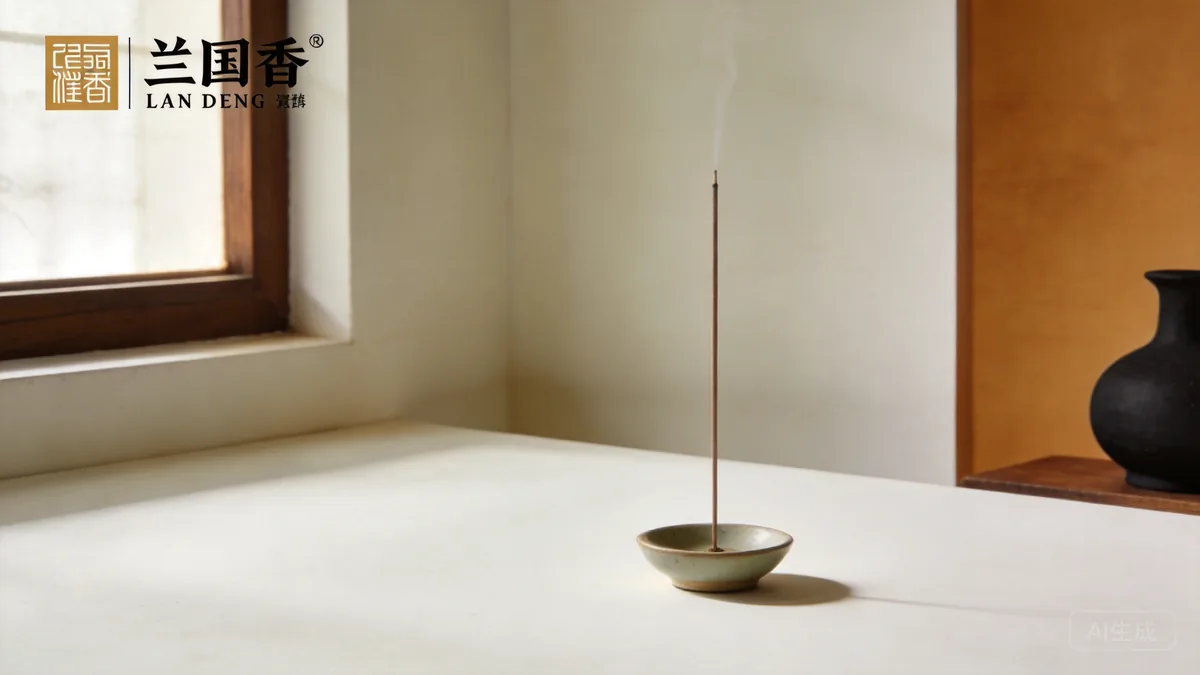
Key facts: A stick’s burn time roughly frames a session — most sticks burn 20–60 minutes (Japanese coreless sticks ~25–30 min; bamboo-core sticks ~45–60 min), while coils burn for hours and cones for only 10–15 minutes. Incense is an ambiance and focus practice, not a treatment — no form of incense “cures” or “relieves” anything.
Key Takeaways
- Incense serves as timer, anchor, and ritual cue in meditation — a practical toolkit, not a magical effect.
- Scent choice centers on calm woods and resins: sandalwood, agarwood, frankincense — soft and long-lasting rather than sharp or sweet.
- Burn time should match your session. A 25–30 min Japanese stick suits a short sit; a 45–60 min stick or a coil suits a longer one.
- The traditional concept of the “incense stick as a unit of time” (一炷香, “one stick of incense”) is a real historical timekeeping practice.
- Compliance line: fragrance supports a calming routine; it does not treat stress, anxiety, or any medical condition. No incense page should claim otherwise.
Why Incense Shows Up in Meditation at All
Strip away the mystique and incense does three concrete jobs in a meditation session:
- Timer. A stick burns for a predictable span. You light it, you sit, and when it goes out the session ends — no clock, no phone. This is the oldest use: in Chinese tradition, “一炷香” (one stick of incense) was a genuine unit of time.
- Anchor. When attention drifts, a single consistent scent gives you something neutral to return to — like the breath, but through smell. (The Japanese kōdō tradition even uses “listen” — 聞 — for this attending-to-fragrance, in its practice of monkō. See Japanese kōdō.)
- Ritual cue. The small act of lighting incense and placing it signals “practice begins now.” That repeated cue is part of what makes a routine stick.
Notice what is not on that list: a claim that the scent itself produces a state of mind. The scent supports the practice; it is not the mechanism.
Formats and Burn Times
Matching format to session length is the most practical decision you can make:
| Format | Typical burn time | Best for |
|---|---|---|
| Japanese coreless stick (~14 cm) | ~25–30 min | Short daily sits |
| Standard bamboo-core stick | ~45–60 min | Longer sessions |
| Cone | ~10–15 min | A brief pause, or a quick room scent |
| Coil 盘香 | Hours | Extended practice, temple use |
| Seal/incense trail 篆香 | Timed, patterned | A deliberate, traditional timed practice |
Burn times vary by manufacturer and thickness; treat these as ranges, not exact numbers. The principle: pick a format whose burn time is close to your intended session length so the incense ends when the sit does.
Choosing a Scent
The traditional meditation scents are the calm woods and resins, chosen for being soft, grounding, and slow rather than sharp or sweet:
| Scent | Character | Why it suits meditation |
|---|---|---|
| Sandalwood 檀香 | Creamy, sweet, soft woody | Gentle and long-lasting; a classic base |
| Agarwood 沉香 | Deep, resinous, evolving | The most storied meditation wood; develops with heat |
| Frankincense 乳香 | Resinous, bright, slightly citrus | Traditional ritual resin, clean and clear |
Lighter florals (lavender, jasmine, osmanthus) and bright citrus also appear in modern blends, but they read more “uplifting” than “settling.” If you want the quietest signal, start with a wood or resin. See the sandalwood, agarwood, and lavender guides for the individual scents.
How to Use It (the Practical Version)
- Light the tip, let it flame, blow it out so the stick glows and smolders rather than flames.
- Place it in a stable holder on a heatproof surface, away from curtains, paper, and anything flammable, and away from children and pets.
- Ventilate. Burning incense produces smoke and particulate matter; a cracked window keeps the air moving without killing the scent. See the smoke discussion.
- Use one scent per session so the anchor stays consistent, rather than switching mid-practice.
- Set the burn time to your sit, not the other way around.
The Compliance Line (Read This)
Meditation is a practice; incense is a sensory aid to that practice. That distinction matters because most of the English web treats “meditation incense” as a wellness product with claims attached — that it relieves stress, reduces anxiety, calms the nervous system, and so on.
LanDeng does not make those claims. Here is the honest position:
- Incense can be part of a calming, focused routine — a timed, sensory ritual.
- It is not a treatment for stress, anxiety, or any medical condition, and it does not “cause” a meditative state.
- Its value is structural (timer + anchor + cue), not pharmacological.
This is not a weaker framing — it is the defensible one, and it is what keeps an incense brand out of the “medical claim” regulatory risk zone.
Common Mistakes
- Believing the scent itself “creates” a meditative state. The scent is an anchor and cue; the practice is yours.
- Ignoring burn time. A 25-minute stick ends halfway through a 45-minute sit (or smolders on after a short one).
- Choosing too sharp or sweet a scent for a quiet sit, then finding it distracting.
- Forgetting ventilation and fire safety — smoke and open flame are real, regardless of the scent.
The Author’s Take
Position: The “timer, anchor, cue” framing is the honest heart of meditation incense — more useful than any scent-ranking article.
Reasoning:
- The stick’s burn does most of the work: it starts the sit and ends it, and the smell is a steady point to return to.
- The moment a seller promises the scent will “deepen” a meditative state, I stop trusting them.
This is the author’s editorial view and experience — not a verified fact.
Verification Notes
- Burn-time ranges are drawn from manufacturer and retailer guidance (Japanese coreless ~25–30 min; bamboo-core ~45–60 min; cones ~10–15 min; coils hours) and are presented as ranges, not exact figures.
- The “一炷香 = one stick of incense” timekeeping tradition is a well-documented cultural practice.
- The “timer/anchor/cue” framing is an original analytical breakdown, not a sourced claim — it is interpretation (I), not fact (F).
- No therapeutic or health claim is made. Fragrance is treated as an ambiance and focus practice only.
See Incense in Daily Ritual: Scent as a Marker of Time and Transition for the full guide.
FAQ
Q: What is the best incense for meditation?
There is no single “best,” but the traditional choices are the calm woods and resins — sandalwood, agarwood, and frankincense. They are chosen because they are soft, long-lasting, and non-distracting rather than sharp or sweet. Sandalwood is creamy and gentle, agarwood is deep and resinous with a character that evolves as it heats, and frankincense is clean and slightly citrus, a classic ritual resin. Lighter florals and bright citrus also appear in modern blends but read more uplifting than settling. Start with a wood or resin, and match the burn time to your session length so the stick ends when your sit does.
Q: How long should I burn incense for meditation?
Match the format to the length of your sit. A Japanese coreless stick burns roughly 25–30 minutes, which suits a short daily session. A standard bamboo-core stick burns roughly 45–60 minutes, and a coil burns for hours, suiting longer sits or extended practice. Cones are shortest at roughly 10–15 minutes. The cleanest setup is for the incense to end when your sit ends, so you don’t sit in a cloud after the practice or leave a stick smoldering. These are ranges, not exact numbers, since burn time varies by manufacturer and thickness. See which incense format for the comparison.
Q: Does meditation incense reduce stress or anxiety?
LanDeng makes no such claim. Meditation incense can be part of a calming, focused routine — a timed, sensory ritual that marks the start of practice and gives the attention a steady anchor. That is a structural role, not a treatment. Incense does not treat, cure, or reduce stress, anxiety, or any medical condition, and no scent reliably changes a mental state through a pharmacological mechanism. Treating the fragrance as a treatment would put the product into medical-claim territory, which is neither accurate nor appropriate. If stress or anxiety is a concern, that is a question for a qualified professional, not for incense.
Q: What does “one stick of incense” mean as a unit of time?
In Chinese tradition, “一炷香” (yī zhù xiāng, “one stick of incense”) was used as a rough unit of time — roughly the span a stick takes to burn, often treated as around half an hour to an hour depending on thickness. It was a practical, pre-clock way to mark a duration, and it appears throughout classical incense culture, including the text 香乘 (Xiang Cheng). Incense seals and trails (篆香, zhuàn xiāng) extended the idea: powdered incense was laid in timed, patterned paths that burned through slowly like a fuse, marking time as they went.
Q: Is a cone or a stick better for meditation?
For most sessions a stick is better, because its burn time — roughly 20–60 minutes — matches a typical sit. A cone burns only about 10–15 minutes, which ends well before most meditation sessions do, leaving you either sitting without the scent or lighting another cone. Cones also tend to produce a denser plume, while a thin stick is gentler in a quiet room. That said, if your practice is a short pause or a brief centering moment, a cone fits fine. Pick by session length, not by shape, and keep the room ventilated either way.
Sources
- Sensing / J-Life International / Incenzo — Japanese incense burn-time guidance.
- Koju / Nippon Kodo — monkō (“listening to incense”) and kōdō practice.
- Cultural references on 一炷香 (“one stick of incense”) as a traditional timekeeping unit.
- Research synthesis: docs/research/chinese-incense-pillar-notes.md (R-003).
- American Lung Association — indoor air pollutants — background on combustion particles, which is why this page stresses ventilation.
- Xiang Cheng (香乘) full text on Wikisource — classical Chinese incense text recording the “一炷香” timekeeping tradition.
Related Resources
Natural next step: the most common meditation wood is sandalwood — read the sandalwood guide to choose between species and avoid synthetic “sandalwood,” or explore the meditation tradition behind kōdō in Japanese incense.