Technical answer: The main incense formats are sticks (the everyday default), backflow cones (a visual waterfall effect), coils (hours-long burn), powder & resin (loose material on heat), and aromatherapy beads (scented bracelets, no burning). The right one depends on burn time, smoke, and whether you want a visual.
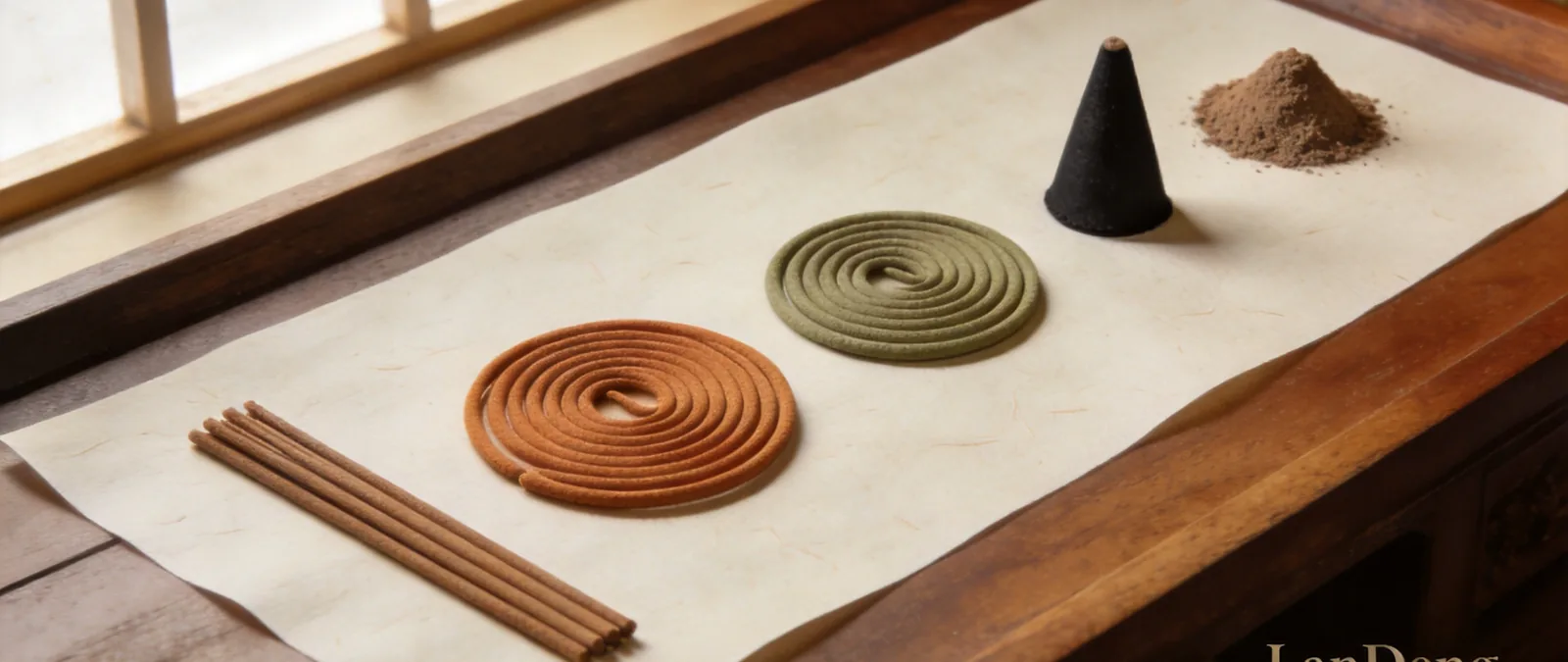
Key facts: A stick burns roughly 20–60 minutes; a cone ~10–15 minutes; a coil can burn for hours; resin is heated, not burned (least smoke); beads are worn, not burned (no smoke at all).
Key Takeaways
- Sticks are the default — predictable, ~20–60 min, low-effort.
- Cones are short (~10–15 min) and often chosen for the backflow visual effect.
- Coils burn for hours — ideal for long, steady scenting.
- Powder & resin are heated (not burned) for a smoke-light, pure-material scent.
- Aromatherapy beads are worn, not burned — a portable, zero-smoke option.
The Formats at a Glance
| Format | Burn time | Smoke | Best for |
|---|---|---|---|
| Stick | ~20–60 min | Moderate | Daily use, meditation, a timed session |
| Cone | ~10–15 min | Moderate | A short ritual, a visual accent |
| Backflow cone | ~10–15 min | High (visual) | The waterfall-smoke effect |
| Coil | Hours | Low-moderate | Long, steady room scent |
| Powder / resin | n/a (heated) | Low | Pure-material scent, incense craft |
| Beads | n/a (worn) | None | Portable scent, no burning |
How to Choose
- Start with burn time. A short session (meditation) → stick or cone; an all-day scent → coil; a “no smoke” preference → resin on a heater or beads.
- Do you want a visual? Backflow cones are chosen almost entirely for their smoke waterfall.
- How pure do you want the material? Resin/powder on heat gives the closest-to-material scent; a stick is more convenient but may carry a binder and (sometimes) fragrance oil.
See how to choose incense for the full selection framework, including material-vs-fragrance.
The Format Pages
- Incense sticks — the everyday default.
- Backflow cones — the visual waterfall effect.
- Incense coils — hours-long burn.
- Incense powder & resin — loose material on heat.
- Aromatherapy beads — worn, not burned.
Why This Hub Reads Different (vs. “Sticks vs Cones” Listicles)
Most “sticks vs cones” content is an affiliate listicle ranking products. This hub compares formats by their actual properties — burn time, smoke, and visual — so you can choose the format that fits your need, not the one that earns a commission.
The Author’s Take
Position: Answer the format question with burn time first, then smoke, then whether you want a visual — and almost everything else follows.
Reasoning:
- Most people default to sticks for good reason, then discover coils for long sessions and backflow cones for the look.
- Format and material are separate choices — a pretty cone with a forgettable scent and a plain stick with real sandalwood solve different wants.
This is the author’s editorial view and experience — not a verified fact.
Verification Notes
- Burn times are ranges and vary by manufacturer; specific products should be checked.
- Smoke levels are qualitative and depend on the material and burn method.
- No health or safety-superiority claims are made across formats.
Related data asset: the burn-time matrix compares burn time across formats and sizes.
Cluster directory
- Aromatherapy Beads & Scented Bracelets: Worn Scent, No Smoke
- Backflow Incense Cones: The Waterfall-Smoke Effect, Explained
- 博山炉 (Boshan Censer): The Mountain Incense Burner of the Han
- 隔火焚香 (Indirect-Fire Incense): How to Scent a Room Without Smoke
- Incense Burn Time & Format Matrix: Stick, Coil, Cone, Resin, Powder
- Chinese Incense Burners & Tools (香炉香具): The Complete Guide
- Incense Coils: The Hours-Long Burn, Explained
- Incense Powder & Resin: The Pure-Material, Smoke-Light Format
- 香篆 (Seal Incense): Powder Pressed Into Patterns, and a Clock
- Incense Sticks: The Everyday Format, Explained
- 香具 (The Incense Tool Set): Chopsticks, Spoons, and the 炉瓶三事
- 宣德炉 (Xuande Censer): The Ming Collector’s Censer
FAQ
Q: Are incense sticks or cones better?
Neither is “better” — they suit different session lengths. A stick burns roughly 20 to 60 minutes, making it the everyday default, while a cone burns only about 10 to 15 minutes, which suits a short ritual or a quick accent. If your session is a half-hour meditation, a stick matches better; if you want a brief burst of scent, a cone is the cleaner choice. Backflow cones are a special case: they are chosen almost entirely for their downward-smoke waterfall effect, not for scent or burn time.
Q: How long does an incense coil burn?
A coil can burn for hours — often several, and a large one can smolder for much of a day. That long, continuous burn is the coil’s defining feature, and it is why coils are the format for temples, long ceremonies, and steady all-day room scenting without needing to relight. Burn time scales with the coil’s diameter and thickness, so check the stated time on the product. See incense coils for how to set one up safely.
Q: What burns the longest?
Coils burn the longest by far — often hours, versus a stick’s 20 to 60 minutes and a cone’s 10 to 15 minutes. If you count heated resin on an electric heater, that can also run for hours, but it is a different method (warming rather than burning). For a single, self-contained burn, the coil is the longest-lasting common format. The catch is that a long burn needs more attention to placement, airflow, and safety. See incense coils for the setup.
Q: What is a backflow cone?
A backflow cone is a hollow incense cone with a channel through its center. When lit, the enclosed channel cools the smoke and makes it denser, so the smoke sinks through the hole at the base and spills downward over a purpose-built burner, creating a waterfall effect. It is chosen for that visual trick, not for its scent — the fragrance is the same as a regular cone. It requires a matching backflow burner, and the heavier smoke means you should ventilate the room. See backflow cones.
More Questions Answered
Q: What is the least smoky format?
Resin or powder warmed on an electric heater is the least smoky option. The heater warms the material below combustion temperature, so it releases aroma as vapor rather than smoke — there is no flame and almost no visible smoke. This is the modern version of the refined 隔火焚香 method. Charcoal-heated resin produces more smoke, and sticks, cones, and coils all burn and produce smoke. If smoke is your main concern — a small room, sensitivity, or a preference for clean air — an electric heater with loose resin is the format to try.
Q: Can I reuse a coil after putting it out?
Yes. You can snuff a coil out partway through and relight the remaining segment later — the spiral keeps burning from the outer tip inward, so the unburned portion stays intact. This is a practical way to break a long, hours-long burn into shorter sessions without wasting material. Make sure the coil is fully out before you leave it, and store the remaining segment somewhere dry until you light it again. The same trick works for a coil more cleanly than for a stick, which is harder to snuff evenly.
Q: Which format is best for a gift?
A stick is the safest, most universal choice — it is self-contained, predictable, and needs only a simple holder, so it suits almost anyone. A cone or a backflow set makes a more visual, gift-worthy present, especially with a matching burner, but it assumes the recipient has (or wants) that setup. If you are unsure of their equipment, a stick plus a basic holder is the lowest-risk option. Match the format to how they are likely to use incense: daily sessions, a decorative moment, or long background scent.
Sources
- The format pages linked above for burn-time and usage detail.
- EPA indoor air quality — background on smoke from burning incense.
- American Lung Association indoor air pollutants — on particulate matter and indoor burning.
Related Resources
- How to Choose Incense
- Incense Sticks
- Backflow Cones
- Incense Coils
- Incense Powder & Resin
- Aromatherapy Beads
Natural next step: start with the sticks (the default) or the coils if you want hours of scent.