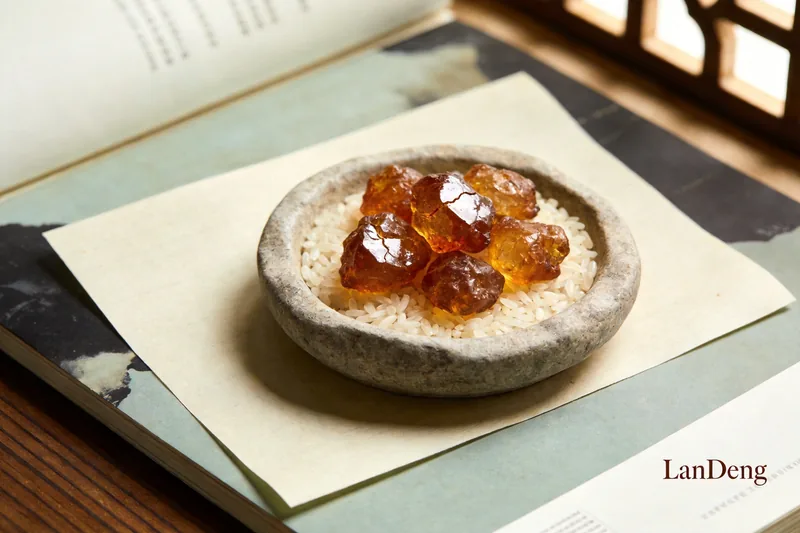
Key takeaway: Sweetgum — fēngxiāng (枫香) in Chinese — is the aromatic resin of the sweetgum tree, Liquidambar formosana (family Altingiaceae). It has a sweet, balsamic, warm aroma and is used in incense and perfumery, where it is closely related to (but distinct from) storax.
Key facts
| Chinese | 枫香 (fēngxiāng); the resin is 枫香脂 (fēngxiāngzhī) |
| Botanical source | Liquidambar formosana (Chinese sweetgum) |
| What it is | A balsamic tree resin |
| Aroma | Sweet, balsamic, resinous, warm |
| Traditional role | Incense, perfumery, traditional use |
Aroma profile
Sweetgum resin has a sweet, warm, balsamic scent with a resinous depth — soft and comforting, in the same broad family as benzoin but with its own character. It reads as a sweet base or supporting note rather than a bright top.
The storax distinction (buyer intelligence)
“Sweetgum” resin and “storax” are often confused, because both come from Liquidambar trees:
- 枫香脂 (fēngxiāngzhī) — resin of Liquidambar formosana, the Chinese sweetgum. This is the material most often meant by “sweetgum” in a Chinese incense context.
- 苏合香 / storax — resin of Liquidambar orientalis (Oriental sweetgum), the classic “storax” of perfumery.
They are related resins from related trees, but not the same product. When a label says “sweetgum” or “storax,” the species matters for the exact aroma and price.
In Chinese tradition
- Incense (香): 枫香脂 is a sweet-balsamic ingredient in Chinese 合香, adding warmth and roundness.
- Traditional use: the resin has been used as an aromatic and in traditional preparations.
- Cultural note: 枫 (maple/sweetgum) trees carry their own seasonal and literary associations in Chinese culture.
Traditional use vs modern evidence
Sweetgum resin appears in traditional uses; we describe its aromatic role and make no medical claims. Its perfumery value is a matter of aroma and fixative character, not health benefit.
Safety
Incense combustion produces smoke and particulate matter; burn in a well-ventilated space and avoid inhaling concentrated smoke. This is editorial knowledge content, not medical advice.
FAQ
Is sweetgum the same as storax? Closely related but not identical — sweetgum resin (枫香脂) comes from Liquidambar formosana, while storax (苏合香) comes from Liquidambar orientalis. They are related resins from related trees. Both come from Liquidambar species, which is the source of the confusion, but they are different products with distinct origins and, to an extent, different aromatic profiles and prices. When a label says “sweetgum” or “storax,” the species matters for the exact aroma.
Is sweetgum a wood or a resin? In incense, “sweetgum” means the resin (枫香脂) tapped from the tree, not the wood itself. The sweetgum tree (Liquidambar formosana) yields a balsamic resin that is the actual incense and perfumery material, in the same broad family as storax and benzoin. So the fragrant material is the sweet-balsamic resin, which is harvested by tapping the tree and letting the exudate harden into tears or a soft mass. When a label lists “sweetgum” without saying resin or wood, it almost always means the resin, since that is the part with commercial fragrance value.
People Also Ask (Long-Tail)
What does sweetgum smell like? Sweet, warm, and balsamic with a resinous depth — a soft, comforting base note in the benzoin family. It reads as a sweet base or supporting note rather than a bright top, with a character that rounds out and warms heavier woods and resins. Soft and comforting, it sits in the same broad family as benzoin but carries its own distinct character rather than being a straight copy.
What is sweetgum resin used for in incense? It adds a sweet-balsamic warmth to blends and acts as a supporting/fixative note, rounding out woods and resins. In Chinese 合香, 枫香脂 is a sweet-balsamic ingredient that adds warmth and roundness to a blend rather than leading the scent itself. As a fixative, it also helps hold the overall composition together and slow the release of lighter top notes. As a fixative, it also helps hold the overall composition together and slow the release of lighter top notes.
How do you burn sweetgum resin? Like other resins — on a lit charcoal disc (in sand or ash) or gently on an electric incense heater, using small pieces at a time. The charcoal method is hotter and smokier; the electric heater is slower and lower in smoke. Burn in a well-ventilated space and avoid inhaling concentrated smoke, and keep the resin stored away from flame and heat.
See also: benzoin, borneol, and the full scent guide.
Sources
Sources: botanical references on Liquidambar formosana and the sweetgum/storax distinction (L. orientalis). This is editorial knowledge content, not medical advice.