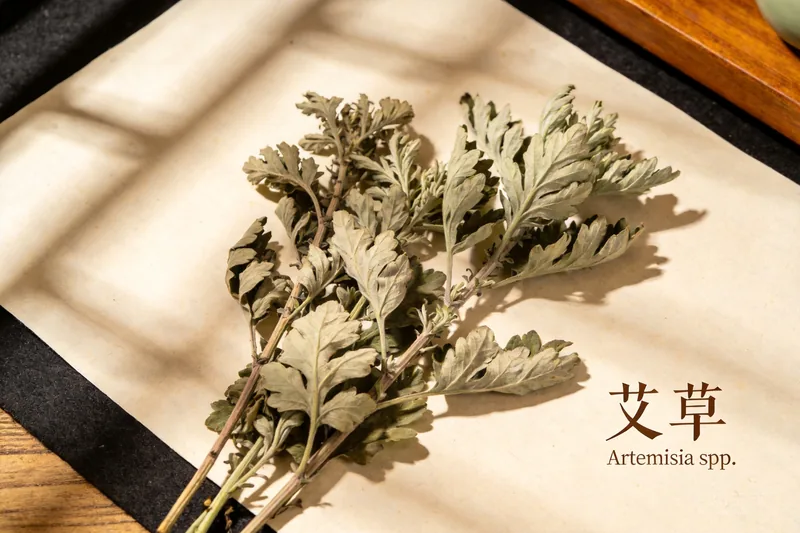
Technical answer: Mugwort — aicǎo (艾草) in Chinese — is a herb in the Artemisia genus with a distinctive herbal, bitter-green, slightly camphoraceous aroma. It is one of the most versatile herbs in Chinese tradition, used fresh or dried, for incense, purification, and (in a separate medical context) moxibustion.
Key facts
| Chinese | 艾草 (àicǎo), also 艾 (ài) |
| Botanical source | Artemisia species (e.g. A. argyi, A. vulgaris) |
| What it is | A dried aromatic herb (not a wood or resin) |
| Aroma | Herbal, bitter-green, slightly camphoraceous |
| Traditional role | Purification, warding insects/“negative energy”, festival use |
Aroma profile
Mugwort’s aroma is herbaceous and slightly bitter-green, with a camphoraceous edge — quite different from the sweet woods (agarwood, sandalwood). It is valued in Chinese tradition less for sweetness than for its association with cleansing and protection.
In Chinese tradition
- Purification / protection: mugwort has long been associated with clearing a space and warding off insects and — in folk tradition — negative influence. It is one of the herbs burned or hung for this purpose.
- Dragon Boat Festival (端午节): hanging mugwort is a well-known seasonal practice around the fifth month.
- Incense: mugwort is a herbal incense material, often blended rather than burned alone.
Mugwort vs moxibustion (a distinction to keep clear)
Mugwort is also the material for moxibustion (灸, jiǔ) — a traditional Chinese medicine therapy that burns dried mugwort (“moxa”) on or near the body.
Important: moxibustion is a medical practice whose claimed benefits are not well-supported by modern evidence (and it carries risk). This is a different domain from burning mugwort as household incense. We describe mugwort’s cultural and incense use; we do not make medical claims about moxibustion or mugwort.
Mugwort in incense blends
Mugwort is usually a supporting note in Chinese 合香 rather than a solo scent — its bitter-green, slightly camphoraceous character adds an earthy, cleansing edge to wood-and-resin blends. It is also burned as a single herb for purification and seasonal use (端午节). Because its aroma is herbal rather than sweet, it is more often blended than burned alone for fragrance.
Safety
Like all burning plant material, mugwort smoke contains particulate matter. Burn in a well-ventilated space and avoid inhaling concentrated smoke. Keep away from children and pets.
FAQ
Is mugwort incense the same as moxibustion? No. Moxibustion is a traditional Chinese medicine therapy that burns dried mugwort, called moxa, on or near the body, and its claimed benefits are not well-supported by modern evidence. Mugwort as incense is household burning for fragrance, purification, and seasonal use — a completely different domain. The same herb appears in both, but the purpose, method, and risk profile are unrelated: moxibustion is a medical practice that carries real risk, while incense burning is a cultural and aromatic activity. This site describes mugwort’s cultural and incense use only and makes no medical claims about moxibustion or the herb itself.
What does mugwort smell like? Mugwort has a herbaceous, bitter-green aroma with a camphoraceous edge, quite different from the sweet woods like agarwood or sandalwood. It reads as green, earthy, and slightly medicinal rather than sweet or floral. In Chinese tradition this character is valued less for sweetness than for its association with cleansing and protection — mugwort is burned or hung to clear a space and, in folk tradition, to ward off insects and negative influence. Because the scent is herbal rather than sweet, mugwort is more often used as a supporting note in blended incense (合香) than burned alone for fragrance, and its edge adds an earthy, cleansing quality to wood-and-resin blends.
People Also Ask (Long-Tail)
What does mugwort smell like? Herbaceous and slightly bitter-green, with a camphoraceous edge — quite different from the sweet woods. Mugwort’s aroma is green, earthy, and faintly medicinal rather than sweet or floral, and it is valued in Chinese tradition less for sweetness than for its association with cleansing and protection. This character makes it a supporting note in blended incense rather than a solo scent. The herb Artemisia argyi (Chinese mugwort) and Artemisia vulgaris (common mugwort) both share this general profile, though the exact balance varies by species and harvest.
What is mugwort used for at Dragon Boat Festival (端午节)? Hanging mugwort around the home is a well-known seasonal practice around the fifth lunar month, tied to the Dragon Boat Festival (端午节). The herb is bundled and hung at doors or windows, a custom associated with warding off insects and — in folk tradition — negative influence, taking advantage of mugwort’s strong, pungent aroma. This is a cultural and seasonal practice, not a medical treatment. The same herb also appears in incense, where it is burned for purification, and in moxibustion, a separate traditional-medicine practice. The festival association is one of mugwort’s most visible roles in Chinese tradition, recurring every year at the start of summer.
What is the difference between mugwort and wormwood? They are close relatives in the Artemisia genus, and both names describe aromatic, bitter-green herbs, which is where much of the confusion comes from. Mugwort most often refers to Artemisia argyi (Chinese mugwort) or Artemisia vulgaris (common mugwort), while wormwood usually means Artemisia absinthium, the bitter herb historically used to flavor absinthe. They share a bitter-herbal family character and some overlap in traditional use, but they are distinct species with different aromas, habitats, and cultural roles. When a label says only “mugwort” or “wormwood” without a species, the plant is underspecified.
Is mugwort safe to burn? Like all burning plant material, mugwort produces smoke and particulate matter when burned, so it should be treated with the same care as any incense. Burn it in a well-ventilated space, avoid inhaling concentrated smoke, and keep it away from children and pets. The smoke can irritate the eyes and airways, especially in poorly ventilated rooms or for anyone sensitive to airborne particles. This is general incense-safety guidance, not a claim about any specific hazard of mugwort. Mugwort is not the same as moxibustion, a separate medical practice that burns the herb near the body and carries its own risks.
Does mugwort incense smell sweet? No — mugwort is herbal and slightly bitter-green with a camphor-like edge, not sweet. Its character is earthy and cleansing rather than sugary or floral, which is why it is valued for its association with purification and protection rather than for sweetness. In a blend, mugwort adds an earthy, slightly medicinal depth that contrasts with sweet woods like sandalwood, and it is rarely burned alone for fragrance. If you are after a sweet, resinous, or floral scent, mugwort is the wrong material; its appeal is its green, bitter-herbal edge, which reads as clean and grounding rather than sweet.
Can mugwort be blended with sandalwood? Yes — mugwort’s herbal-green note is sometimes paired with a sweet wood like sandalwood in blended incense (合香). The combination works by contrast: sandalwood’s warm, creamy sweetness softens mugwort’s bitter-herbal edge, while mugwort adds an earthy, cleansing character that keeps the blend from becoming too sweet. This kind of pairing — a pungent herb against a sweet base wood — is common in Chinese incense blending. The exact ratio matters, since mugwort is strong and a little goes a long way; too much can overpower the wood. The result is a balanced blend with both sweetness and a green, earthy backbone.
See also: what Chinese incense is and the full scent guide.
Sources
Sources: botanical references on Artemisia and cultural accounts of mugwort’s traditional role. Moxibustion’s medical claims are treated as not established by modern evidence. This is editorial knowledge content, not medical advice.