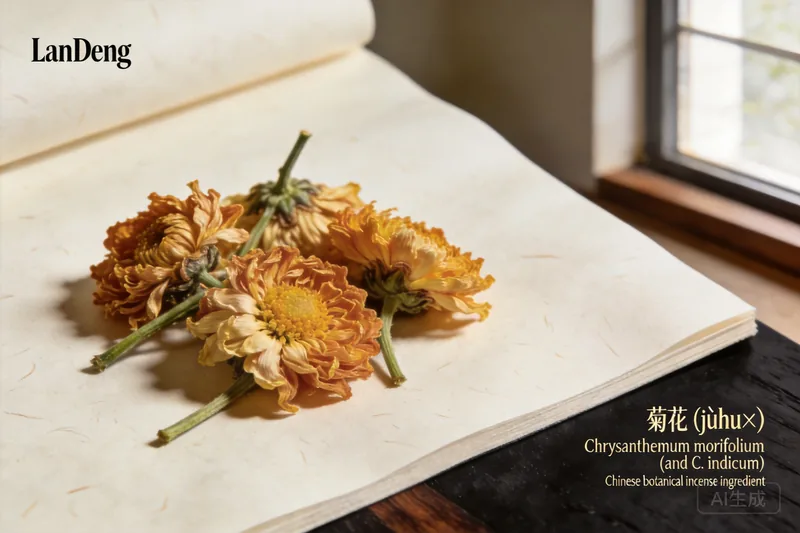
At a glance: Chrysanthemum — júhuā (菊花) in Chinese — is the flower of Chrysanthemum morifolium, widely drunk as an herbal tea and used in traditional materia medica. It has a light floral-herbal aroma with a bittersweet edge.
Key facts
| Chinese | 菊花 (júhuā) |
| Botanical source | Chrysanthemum morifolium (Asteraceae) |
| What it is | A dried flower |
| Aroma | Floral, herbal, bittersweet |
| Traditional role | Tea, food, materia medica |
Aroma profile
Chrysanthemum has a delicate floral-herbal scent, less sweet than jasmine or rose, with a slightly bitter, “green” quality. It is most familiar as a tea aroma (菊花茶).
The scent is closer to a dried meadow herb than to a lush perfume flower. Where jasmine is heady and rose is sweet, chrysanthemum is cool and dry — a light, airy note with a faint bitter-herbal finish. In incense it reads as a subtle, “cooling” herbal floral, quite different from the warm woods and resins of the classical canon.
Varieties (a buyer’s note)
“菊花” covers many cultivated forms of C. morifolium, and the named varieties differ:
- 杭白菊 (Hangzhou white) — the classic pale “chrysanthemum tea” flower.
- 贡菊 (tribute chrysanthemum) — a tight, small flower from Huangshan, also drunk as tea.
- 亳菊 / 滁菊 — medicinal-grade varieties named for their producing regions (Bozhou, Chuzhou).
The aroma differences are subtle; the regional names mainly signal grade and intended use (tea vs materia medica) rather than a dramatic change in scent.
In Chinese tradition
- Tea (菊花茶): dried chrysanthemum is a classic herbal tisane, enjoyed for its light, cooling character.
- Materia medica: in traditional Chinese medicine, chrysanthemum is described for the eyes and liver and for “dispersing wind-heat” — traditional language, not modern clinical fact.
- Culture: chrysanthemum is one of the “Four Gentlemen” (四君子) of Chinese art, alongside plum, orchid, and bamboo — and is central to the Double Ninth Festival (重阳节), where it symbolizes longevity and the autumn season.
The Double Ninth association is worth knowing: chrysanthemum’s cultural weight in China is tied to autumn and longevity, which is why it appears in poetry, painting, and festival ritual far beyond its role as a tea.
Traditional use vs modern evidence
Chrysanthemum has a long record of use as a tea and food; modern research on its phytochemicals (flavonoids like luteolin, chlorogenic acid) exists but is largely preclinical (cell and animal studies). We describe its tea and cultural use; we do not make medical claims (e.g. “cures colds,” “lowers blood pressure,” “protects eyesight”).
Safety
Chrysanthemum is food-grade and widely drunk as tea; however, incense combustion produces smoke and particulate matter — burn in a well-ventilated space. People with ragweed-family (Asteraceae) allergies may wish to be cautious with chrysanthemum, though this is more relevant to tea than to incense.
FAQ
Is chrysanthemum tea a medicine? Chrysanthemum tea is a traditional tisane and food, not a medicine in the modern clinical sense. In traditional Chinese medicine, chrysanthemum is described for the eyes and liver and for “dispersing wind-heat,” but this is traditional language rather than modern clinical evidence. Modern research on its phytochemicals, such as the flavonoids luteolin and chlorogenic acid, is largely preclinical — based on cell and animal studies. We describe chrysanthemum’s tea and cultural use and make no claim that it treats or cures any condition.
Is chrysanthemum the same as chamomile? No. Chrysanthemum is Chrysanthemum morifolium (family Asteraceae), while chamomile is a different genus — Matricaria or Chamaemelum, also in the Asteraceae family. They share a loose floral-herbal family resemblance, but they are different plants with different aromas, appearances, and uses. Chrysanthemum is a staple of Chinese tea culture and materia medica, whereas chamomile is a European herb most familiar as a calming tisane. The two names should not be used interchangeably.
People Also Ask (Long-Tail)
What does chrysanthemum smell like? Chrysanthemum has a delicate, floral-herbal, slightly bittersweet scent, less sweet than jasmine or rose, with a faint “green” quality. It is most familiar as the aroma of chrysanthemum tea (菊花茶), and it reads closer to a dried meadow herb than to a lush perfume flower. Where jasmine is heady and rose is sweet, chrysanthemum is cool and dry — a light, airy note with a faint bitter-herbal finish that sets it apart from warm woods and resins.
Is chrysanthemum used in incense? Yes, chrysanthemum appears as a herbal-floral incense material, though it is usually blended rather than burned alone. Its scent is light, cool, and subtly herbal rather than sweet, so it works as a supporting note that adds an airy, “cooling” quality. It is less common than the woods and resins of the classical canon, but its delicate floral-herbal character makes it useful in formulas that call for a lighter, non-sweet floral element.
What are the “Four Gentlemen” (四君子)? The Four Gentlemen (四君子) are the four plants canonized in Chinese art and culture: plum, orchid, bamboo, and chrysanthemum. Each represents a virtue and a season, and together they are a recurring subject in Chinese painting, poetry, and literati tradition. Chrysanthemum’s inclusion reflects its cultural standing far beyond its role as a tea — it symbolizes autumn and longevity. The concept is a cultural and artistic convention rather than a botanical grouping.
Is chrysanthemum the same as chamomile? No. Chrysanthemum is Chrysanthemum morifolium, while chamomile belongs to a different genus — Matricaria or Chamaemelum. Both are in the aster family (Asteraceae), which explains the loose resemblance in their floral-herbal character, but they are different plants with different aromas and uses. Chrysanthemum is central to Chinese tea culture and materia medica and is drunk as 菊花茶, whereas chamomile is a European herb best known as a relaxing tisane. The two should not be treated as interchangeable.
What is chrysanthemum associated with in Chinese culture? Chrysanthemum is associated with autumn and longevity. It is central to the Double Ninth Festival (重阳节), a traditional autumn festival where chrysanthemum symbolizes long life, and it is one of the Four Gentlemen (四君子) of Chinese painting and poetry, alongside plum, orchid, and bamboo. This cultural weight means chrysanthemum appears in poetry, painting, and festival ritual far beyond its role as a tea, giving it a prominence that other flowers do not share in Chinese tradition.
Is chrysanthemum incense safe? Like all burning plant material, chrysanthemum produces smoke and particulate matter, so burn it in a well-ventilated space and avoid inhaling concentrated smoke. This is general safety guidance that applies to every incense material, not a claim about chrysanthemum specifically. Separately, people with ragweed-family (Asteraceae) allergies may wish to be cautious with chrysanthemum, though that concern is more relevant to drinking the tea than to burning the flower as incense.
See also: mugwort, another herbal (non-sweet) Chinese incense material, and the full scent guide.
Sources
Sources: botanical references on Chrysanthemum morifolium and TCM accounts of 菊花 (varieties, festival association). Medicinal claims are treated as traditional. This is editorial knowledge content, not medical advice.