
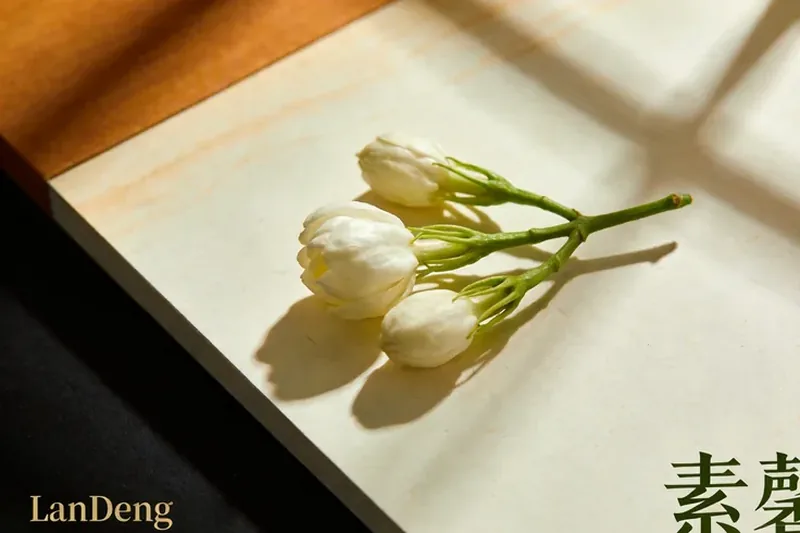
Direct answer: Jasmine grandiflorum (素馨, sùxīn) is the flower of Jasminum grandiflorum, the Spanish or royal jasmine, a climbing shrub of the olive family (Oleaceae) with large, intensely fragrant white flowers. It is the classic Western perfumery jasmine — the source of much jasmine absolute — and is recorded in the Chinese compendium 香乘 alongside its close relative 茉莉 (Jasminum sambac). The two jasmines are distinct species.
Key facts
| Chinese | 素馨 (sùxīn) — also 素馨花 |
| Botanical source | Jasminum grandiflorum (family Oleaceae) — the flowers |
| What it is | A flower, not a wood or resin |
| Aroma | Sweet, floral, heady, green |
| Traditional role | Perfumery jasmine; incense flower (香乘) |
Aroma profile
Direct answer: 素馨 is intensely sweet and white-floral, with a heady, almost indolic depth that is richer than 茉莉’s tea-like sweetness. In natural absolute form it carries a warm, animalic undercurrent beneath the green-floral top; commercial jasmine notes are usually rendered cleaner and brighter.
素馨 is intensely sweet and white-floral, with a heady, almost indolic depth that is richer than 茉莉’s tea-like sweetness. In natural absolute form it carries a warm, animalic undercurrent beneath the green-floral top; commercial jasmine notes are usually rendered cleaner and brighter. In a blend it pushes the scent toward opulent and romantic, where 茉莉 reads fresher and more delicate.
The register is worth pinning against 茉莉: 素馨’s heady, indolic depth is the difference between the “perfumery” jasmine and the “tea” jasmine. The indolic note — a warm, animalic, almost narcotic undertone — is what gives 素馨 its opulent richness, and it is the very note that commercial perfumery often tames or brightens. This is the sensory core of the 素馨/茉莉 distinction, and it is why the two flowers, though both sweet white jasmines, serve different fragrance registers.
The Spanish jasmine (素馨) / jasmine (茉莉) distinction (read this)
Direct answer: Two Jasminum species sit at the centre of Chinese and global jasmine: 素馨 (Jasminum grandiflorum), the headier Western perfumery jasmine, and 茉莉 (Jasminum sambac), the fresher tea-scented jasmine. They are distinct species, and 香乘 lists them together as separate flowers.
Two Jasminum species sit at the centre of Chinese and global jasmine:
- 素馨 (Jasminum grandiflorum) — the “Spanish/Poet’s/royal jasmine,” larger flowers, the classic Western perfumery jasmine and jasmine-absolute source. This entry.
- 茉莉 (Jasminum sambac) — the tea-scented jasmine, the classic Chinese tea-and-fragrance jasmine. Its own entry.
Both appear together in the classical record — 香乘 lists 素馨 and 茉莉 as distinct flowers (for example, in 心字香 and in the ten-flower recipe 逗情香). This page describes 素馨 = Jasminum grandiflorum. When a source means 茉莉, it is describing Jasminum sambac.
This distinction is the page’s core value: “jasmine” in English is not one plant, and a label saying only “jasmine” underspecifies which species — the heady perfumery jasmine (素馨) or the fresh tea jasmine (茉莉). The classical 香乘 record is itself evidence of the distinction, listing the two flowers side by side as separate materials.
Botanical source and origin
Direct answer: Jasminum grandiflorum is a scrambling evergreen shrub of the olive family (Oleaceae), native to South Asia and long cultivated across warm regions, including southern China. Its flowers are larger than those of J. sambac, white, and powerfully fragrant, opening at night. It is the principal source of commercial jasmine absolute.
Jasminum grandiflorum is a scrambling evergreen shrub of the olive family (Oleaceae), native to South Asia and long cultivated across warm regions, including southern China. Its flowers are larger than those of J. sambac, white, and powerfully fragrant, opening at night. Flora of China records the species (素馨花) as a scandent shrub 2–4 m, with pinnately compound leaves and white, salverform flowers, noting it is native to Arabia and widely cultivated in warm and tropical countries for its fragrant flowers. It is the principal source of commercial jasmine absolute and concrete for Western perfumery — the “jasmine” of fine fragrance in a way 茉莉 is not.
Chinese name and terminology
Direct answer: 素馨 (sùxīn) — also 素馨花 — means roughly “plain/simple fragrance” (素 “plain, white, unadorned” + 馨 “fragrance”). It is a distinct name from 茉莉 (Jasminum sambac), and 香乘 records the two as separate flowers, which is the classical evidence that 素馨 and 茉莉 are not interchangeable.
The name 素馨 (also 素馨花) combines 素 (“plain, white, unadorned”) with 馨 (“fragrance”) — a name evoking the white flower’s pure, unadorned scent. It is a distinct name from 茉莉 (Jasminum sambac), and the two do not overlap in the classical record: 香乘 lists 素馨 and 茉莉 as separate flowers in the same formulas (心字香, 逗情香), which is itself the classical evidence of the distinction. A reader who meets 素馨 should read it as the heady perfumery jasmine, not as the tea jasmine 茉莉 — the two names track two species.
Why is it used in incense and fragrance?
Direct answer: 素馨 is recorded in 香乘 as an incense and scenting flower, and it is the archetypal jasmine of Western fine fragrance — the principal source of jasmine absolute. In Chinese incense it appears as a flower material, often paired with 茉莉; in perfumery it supplies the heady, opulent white-floral note that defines “jasmine.”
素馨’s role is double: it is a classical Chinese incense flower and the Western perfumery jasmine. In the 香乘 record it appears as a flower for incense and scenting — in 心字香 and in the ten-flower 逗情香 recipe, where it is paired with 茉莉 and other flowers — and the classical scenting method was to steam the flowers to capture their scent (蒸香). In perfumery it is the archetypal jasmine: the principal source of jasmine absolute and concrete, valued for the heady, indolic, opulent white-floral note that 茉莉’s fresher character cannot supply. The two roles share the flower but point to different registers — one a classical paired flower, the other a modern fine-fragrance staple.
How is it processed?
Direct answer: 素馨’s flowers are processed by picking the freshly opened blooms and, for perfumery, extracting them into jasmine absolute or concrete by solvent extraction; the classical Chinese method was steaming the flowers to capture their scent (蒸香). The flowers are delicate and must be picked at the right moment for their scent.
For perfumery, the freshly opened 素馨 flowers are picked and extracted — by solvent extraction into jasmine absolute or concrete, since the flowers’ scent is too delicate for steam distillation. The classical Chinese method was different: sources describe steaming 素馨 and other fragrant flowers to capture their scent (蒸香), a gentler approach suited to the flower’s fragility. The practical point is the flower’s delicacy: 素馨 blooms must be picked at the right moment (just opened, at night or early morning) for their full scent, and the extraction method must not heat the flowers destructively.
What determines quality?
Direct answer: 素馨 quality turns on the intensity and richness of the flower’s scent — a full, heady, white-floral character with the indolic depth that defines the perfumery jasmine. In absolute form, the quality is judged on the purity and richness of the floral note, not on the raw flower’s appearance alone.
For a buyer, the practical checks are: scent intensity (a full, heady, sweet white-floral character with the characteristic indolic depth), richness (the opulent, almost animalic undertone that separates 素馨 from the fresher 茉莉), and — for the absolute — purity (a clean floral note, not a synthetic or diluted substitute). Because 素馨’s value is in its heady, indolic richness, a flat or merely “clean” jasmine note is likely the wrong material or a thinned product.
Common forms
Direct answer: 素馨 is traded as fresh flowers (for classical scenting), as jasmine absolute and concrete (for perfumery), and as a fragrance accord (in compounds). The absolute is the commercial reference form; the fresh flower is the classical scenting form.
| Form | Typical use |
|---|---|
| Fresh flowers | Classical scenting (蒸香) and display |
| Jasmine absolute / concrete | Solvent-extracted perfumery concentrate |
| Fragrance accord | The jasmine note rendered in compounds |
The absolute is the perfumery reference form; the fresh flower is the classical material, and the accord is a convenience form.
In Chinese tradition
- Incense flower: 素馨 is recorded in 香乘 as a flower for incense and scenting — for example, in 心字香 (番禺人作心字香 用素馨茉莉半开者) and in the ten-flower 逗情香 recipe.
- Scenting method: classical sources describe steaming 素馨 and other fragrant flowers to capture their scent (蒸香).
- Perfumery: globally, 素馨 is the archetypal jasmine of fine fragrance, distinct from the tea jasmine.
Traditional use vs modern evidence
Direct answer: The aromatic and incense use of 素馨 is documented in classical and modern perfumery records; its botanical identity is established. No medical claim is made. The page’s core factual point is the 素馨/茉莉 distinction — two jasmines listed separately in 香乘.
- Traditional Use — 素馨 as a classical incense and scenting flower, paired with 茉莉 in 香乘 formulas.
- Historical Record — 香乘 lists 素馨 and 茉莉 as distinct flowers (心字香, 逗情香); the classical scenting method was steaming (蒸香).
- Scientific Evidence — the botanical identity (Jasminum grandiflorum, Oleaceae) is established. No clinical or medical efficacy claims are presented.
The aromatic and incense use is documented in classical and modern perfumery records. We make no medical claims. The documented, non-medical facts are botanical identity, the Oleaceae placement, and the sweet heady floral use — plus the 素馨/茉莉 species distinction that is the page’s core.
Quality and sourcing notes
Practical points for buyers:
- Distinguish 素馨 (Jasminum grandiflorum) from 茉莉 (Jasminum sambac) — different jasmines with different scent character, and a label saying only “jasmine” is underspecified.
- True jasmine absolute is costly and delicate; in incense the scent is often carried as an accord over a wood or resin base.
- Expect a headier, more opulent white-floral character from 素馨 than from the tea-fresh 茉莉.
- The indolic depth is the tell — a flat or merely “clean” jasmine is likely the wrong material or a thinned product.
Spanish jasmine (素馨) vs jasmine (茉莉): the jasmine species distinction
Direct answer: 素馨 and 茉莉 are two distinct Jasminum species with different scent character. 素馨 (Jasminum grandiflorum) is the headier, larger-flowered perfumery jasmine; 茉莉 (Jasminum sambac) is the fresher, tea-scented jasmine. 香乘 lists them separately, and each has its own entry here.
| 素馨 (J. grandiflorum) | 茉莉 (J. sambac) | |
|---|---|---|
| Flower | Larger, more intensely fragrant | Smaller, tea-scented |
| Character | Heady, indolic, opulent | Fresh, tea-like, delicate |
| Perfumery role | Jasmine absolute/concrete source | Tea-scenting jasmine |
| Classical record | Listed in 香乘 (心字香, 逗情香) | Listed in 香乘 (alongside 素馨) |
The two are distinct species with distinct registers, listed separately in the classical record. See jasmine, osmanthus, and the material comparison matrix.
Our Industry View
Direct answer: 素馨 is a “same-genus-different-species” case — “jasmine” is not one plant, and a label saying only “jasmine” underspecifies between the heady perfumery jasmine (素馨) and the fresh tea jasmine (茉莉). The classical 香乘 record, listing the two flowers side by side, is itself the evidence of the distinction.
From a sourcing and editorial perspective, 素馨 is most interesting for the underspecification risk that the word “jasmine” itself creates. Three points follow:
- “Jasmine” is a genus, not a material. 素馨 (Jasminum grandiflorum) and 茉莉 (Jasminum sambac) are different species with different scent characters, and the English word “jasmine” collapses them. A sourcing spec that says “jasmine” without the species is underspecified in exactly the way a spec saying “pepper” or “citrus” would be. The heady, indolic perfumery jasmine and the fresh, tea-like jasmine are not interchangeable.
- The classical record does the disambiguation for us. 香乘 lists 素馨 and 茉莉 as separate flowers in the same formulas — 心字香 and 逗情香 — which is the classical evidence that the distinction was recognized. This is a source-quality point: a knowledge resource that cites the classical listing is citing the distinction itself, not merely asserting it.
- The indolic note is the real tell, and it carries a sourcing lesson. 素馨’s heady, almost animalic indolic depth is what separates it from 茉莉, and it is also the note that commercial perfumery often tames or brightens. For a buyer, this means the “jasmine” that arrives too clean and bright may be a thinned or reformulated product, not the full 素馨 absolute. The richness of the indolic note is the quality signal.
In our view, 素馨 is best understood as the heady, indolic perfumery jasmine in a genus that the word “jasmine” underspecifies — a classical 香乘 flower that is also the Western fine-fragrance jasmine, distinct from the tea-scented 茉莉, and best sourced by species rather than by the shared name.
Summary
素馨 (sùxīn), jasmine grandiflorum, is the flower of Jasminum grandiflorum, an olive-family (Oleaceae) climbing shrub native to South Asia and cultivated in southern China. It is the heady, indolic perfumery jasmine — the principal source of jasmine absolute — and a recorded classical incense flower in 香乘, where it is listed alongside the tea-scented 茉莉 (Jasminum sambac) as a distinct species. Its key point is the 素馨/茉莉 distinction, and a label saying only “jasmine” underspecifies between the two.
FAQ
What is 素馨 (suxin)? The flower of Jasminum grandiflorum, the Spanish or royal jasmine, a climbing shrub of the olive family (Oleaceae) with large, intensely fragrant white flowers. It is the classic Western perfumery jasmine and a principal source of jasmine absolute. It is recorded in the Chinese incense compendium 香乘 alongside its close relative 茉莉 (Jasminum sambac).
How does Spanish jasmine (素馨) differ from jasmine (茉莉)? Both are Jasminum species, but distinct. 素馨 is Jasminum grandiflorum — larger flowers, headier and more opulent, the classic perfumery jasmine. 茉莉 is Jasminum sambac — the tea-scented jasmine used for jasmine tea. 香乘 lists them as separate flowers (for example, in 心字香 and 逗情香), and each has its own entry here.
What does Spanish jasmine (素馨) smell like? Intensely sweet and white-floral, with a heady, almost indolic depth richer than 茉莉’s tea-like sweetness. In natural absolute form it carries a warm, animalic undercurrent beneath a green-floral top; commercial jasmine notes are usually rendered cleaner and brighter. In a blend it reads opulent and romantic.
Is Spanish jasmine (素馨) used in perfumery? Yes — it is the archetypal jasmine of Western fine fragrance and the principal source of commercial jasmine absolute and concrete. Its large, night-opening white flowers are picked for their intense scent and processed into absolute and concrete. In Chinese incense it appears as a flower material in 香乘, often paired with 茉莉.
What does the name Spanish jasmine (素馨) refer to? The flower of Jasminum grandiflorum (also 素馨花). It is distinct from 茉莉 (Jasminum sambac), the tea jasmine. Both are olive-family (Jasminum) climbers with sweet white flowers, but 素馨 is the headier, larger-flowered perfumery species, while 茉莉 is the fresher tea-scented species.
Why should I specify the jasmine species when sourcing? Because “jasmine” names a genus, not a material. 素馨 (Jasminum grandiflorum) and 茉莉 (Jasminum sambac) are different species with different scent characters — heady and indolic versus fresh and tea-like — and they are not interchangeable. A spec that names the species avoids the underspecification the word “jasmine” invites.
See also: jasmine, osmanthus, and the full scent guide.
Evidence & Sources
Botanical identity
Source: Jasminum grandiflorum in Flora of China · Jasminum grandiflorum on GBIF. Evidence type: Established.
Traditional Chinese use
Source: 素馨 as an incense and scenting flower in 香乘 (心字香, 逗情香). Evidence type: Historically documented — classical incense record.
Authenticity / disambiguation
Source: 素馨 (Jasminum grandiflorum) vs 茉莉 (Jasminum sambac) — distinct jasmines, listed separately in 香乘. Evidence type: Practical screening.
Safety
Source: incense combustion produces smoke and particulate matter; burn in a well-ventilated space. Evidence type: Established.
Evidence status
| Layer | Status |
|---|---|
| Botanical identity | Established |
| Traditional use | Historically documented |
| Authenticity test | Practical screening |
| Health claims | Not established |
Sources
Sources: botanical references on Jasminum grandiflorum and the suxin-vs-moli distinction. 素馨 is recorded as an incense flower in 香乘; no medical claims are made. This is editorial knowledge content, not medical advice.