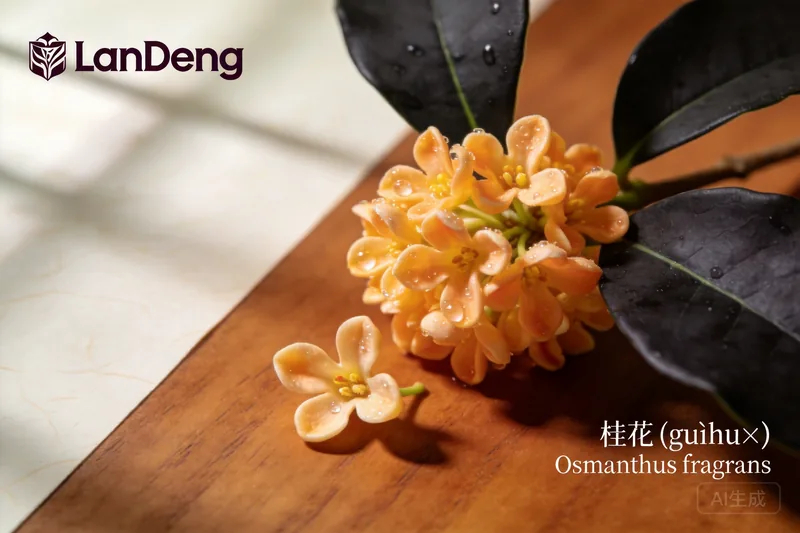
Definition: Osmanthus — guìhuā (桂花) in Chinese — is the small golden flower of Osmanthus fragrans, prized for a sweet, apricot- and honey-like fragrance. It is a classic Chinese fragrance, used in tea, desserts, and incense.
Key facts
| Chinese | 桂花 (guìhuā) |
| Botanical source | Osmanthus fragrans (olive family, Oleaceae) |
| What it is | A dried flower (not a wood or resin) |
| Aroma | Sweet, floral, apricot/honey |
| Traditional role | Fragrance, tea, desserts, incense |
Aroma profile
Osmanthus has a distinctly sweet, fruity-floral scent — often described as ripe apricot or peach with a honeyed, nectar-like quality. It is a bright, uplifting note, very different from the deep woods (agarwood, sandalwood) and often used to add a sweet floral lift to blends.
The signature of osmanthus is its fruity sweetness — more apricot-and-honey than rose’s romantic florality or jasmine’s heady white-floral. It is one of the few flowers whose scent is naturally described as “fruity,” which makes it distinctive in the floral family and a favorite for rounding out heavier woods.
Varieties (a note on 金桂 / 银桂 / 丹桂)
Osmanthus fragrans has several color variants, each with a slightly different character:
- 金桂 (gold osmanthus) — golden-yellow, the richest and most fragrant.
- 银桂 (silver osmanthus) — pale/white, lighter scent.
- 丹桂 (red osmanthus) — orange-red, less fragrant.
- 四季桂 (four-seasons osmanthus) — a less fragrant variety that blooms repeatedly.
In fragrance and tea, the golden (金桂) type is the reference. The color names appear in Chinese sources and product labels, so they are useful to recognize.
In Chinese tradition
- Fragrance: a classic Chinese floral fragrance, dating back at least to the Tang dynasty.
- Tea (桂花茶): osmanthus flowers are commonly blended with tea or brewed as a floral tisane.
- Food: used to flavor desserts, sugar, and confections (桂花糕, 桂花酒).
- Incense: osmanthus is a floral incense ingredient, often paired with woods — a classic pairing is osmanthus with agarwood (沉香).
- Season: O. fragrans is famous for its strong autumn bloom, which ties it to mid-autumn (中秋) in Chinese culture.
Osmanthus vs jasmine
Both are sweet Chinese florals, but they sit apart: osmanthus is fruity-apricot-honey, while jasmine is heady and white-floral. Osmanthus is brighter and more delicate; jasmine is richer and more opulent. In a blend, osmanthus lifts and sweetens, while jasmine romanticizes.
Botanical note
Osmanthus fragrans belongs to the olive family (Oleaceae), which is why it is also called “sweet olive” or “fragrant tea olive.” This is a helpful disambiguation: “osmanthus” is a flower, not a wood or resin.
Safety
Osmanthus is a gentle floral note and is commonly used in tea and food; however, incense combustion still produces smoke and particulate matter. Burn in a well-ventilated space. (Do not assume a food-safe flower implies its smoke is harmless to inhale.)
FAQ
Is osmanthus a wood or a flower? A flower — the bloom of Osmanthus fragrans (olive family). It is used dried in tea, food, and incense. The plant is an evergreen shrub or small tree in the Oleaceae family, also called “sweet olive” or “fragrant tea olive,” but the fragrant material used in fragrance is the small golden flower, not the wood. This is a helpful disambiguation: osmanthus is a delicate floral note, not a heavy wood or resin.
What does osmanthus pair with? Its sweet apricot-honey florals pair well with woods like agarwood and sandalwood, where it adds a bright, sweet lift. The classic pairing is osmanthus with agarwood (沉香), which the flower rounds out and sweetens; it also pairs naturally with other florals such as jasmine and rose. Its fruity-sweet character makes it useful for lightening heavier, deeper wood-and-resin blends without covering them.
People Also Ask (Long-Tail)
What does osmanthus smell like? Distinctly sweet and fruity-floral — often described as ripe apricot or peach with a honeyed, nectar-like quality. It is a bright, uplifting note, and one of the few flowers whose scent is naturally described as “fruity,” which sets it apart within the floral family. More apricot-and-honey than rose’s romantic florality or jasmine’s heady white-floral, it is a favorite for rounding out heavier woods.
What is osmanthus tea? Osmanthus flowers brewed as a floral tisane or blended with tea leaves (桂花茶). It carries the same sweet apricot-honey aroma. The dried flowers are steeped alone or mixed into green or oolong tea, giving a delicate, fruity-sweet cup that is a classic of Chinese tea culture. Because the flowers are small and fragrant, only a small amount is needed to flavor a pot.
When does osmanthus flower? In autumn — Osmanthus fragrans is famous for its strong autumn bloom, and the flower’s timing is part of its cultural association with mid-autumn. The small golden flowers open in clusters and are known for their powerful, far-reaching fragrance, which is why the plant is celebrated as a seasonal marker in Chinese culture. This autumn bloom is a distinctive trait that ties osmanthus to the mid-autumn festival.
Is osmanthus a wood or a flower? A flower — the bloom of Osmanthus fragrans (olive family, Oleaceae). It is used dried in tea, food, and incense. Although the plant itself is an evergreen shrub or small tree, the fragrant material is the flower, not the wood or resin. The name “sweet olive” or “fragrant tea olive” reflects its olive-family membership, but in fragrance it is a light floral note.
What is the difference between 金桂 and 丹桂? Both are Osmanthus fragrans color variants: 金桂 (gold) is the most fragrant, 丹桂 (red) is less so. The gold type is the reference for fragrance and tea. A third variant, 银桂 (silver), is paler with a lighter scent, and 四季桂 (four-seasons) is a less fragrant type that blooms repeatedly. Recognizing these color names is useful because they appear on Chinese product labels and indicate the likely strength and character of the scent.
What is osmanthus used for in food? It flavors desserts, sugar syrups, and confections — 桂花糕 (osmanthus cake) and 桂花酒 (osmanthus wine) are the classic examples — adding a sweet, apricot-honey note. The dried flowers are also steeped into syrups and jams to carry the fruity-floral flavor into sweets, and they are sometimes mixed into sugar for a fragrant, floral sweetener used widely across southern Chinese cooking.
See also: jasmine and rose, its fellow florals, plus the full scent guide.
Sources
Sources: botanical references on Osmanthus fragrans (Oleaceae, color variants) and commercial/cultural accounts of its use in tea and incense. This is editorial knowledge content.