Data summary: The world’s major incense traditions are regional “schools” that differ in form (stick, coil, chip, resin), scent character, and ritual purpose. The four most distinct — aside from Chinese incense — are Japanese kōdō (minimalist, low-smoke), Indian agarbatti (bold, expressive), Tibetan incense (herbal, recipe-based), and Middle Eastern bakhoor/oud (wood chips and resin, hospitality-driven).
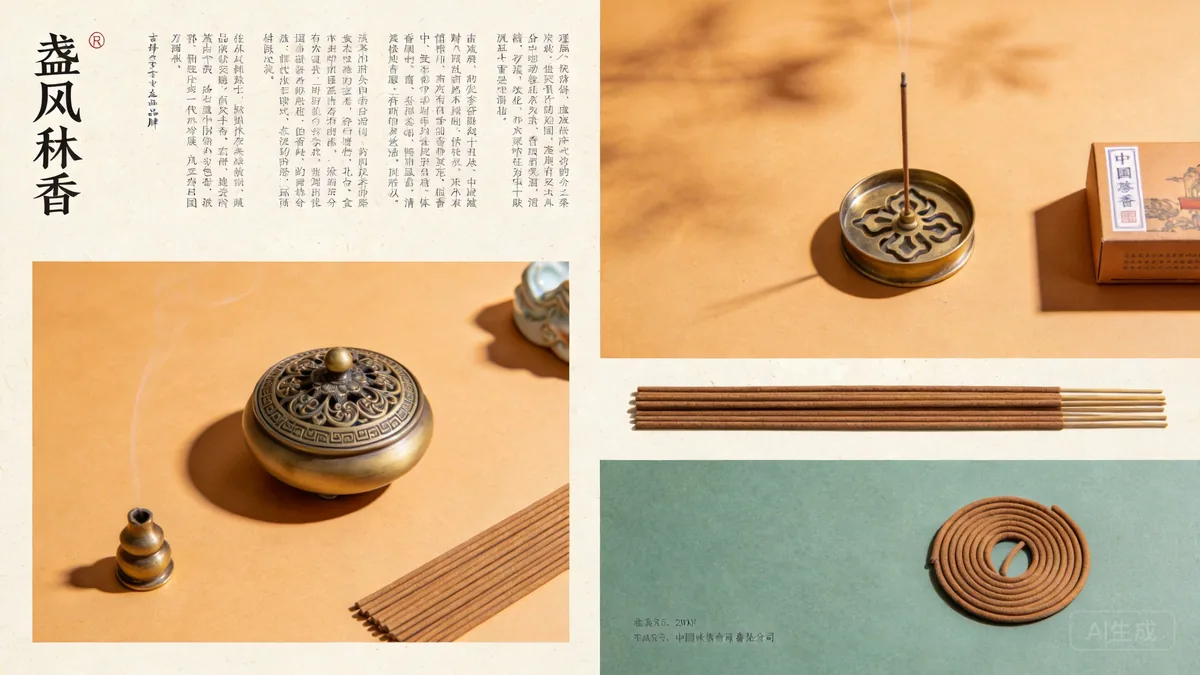
Key facts: Chinese incense is the historical source of the East Asian traditions; Japan systematized it into kōdō; India and Tibet each built a distinct form around ritual; the Middle East built its tradition around oud and frankincense rather than sticks.
Key Takeaways
- Incense traditions differ by form, scent, and purpose — not just by geography.
- Chinese incense is the historical root: warmer, layered, and home to the refined 隔火焚香 (indirect-fire) technique.
- Japanese kōdō is a formalized, minimalist art descended from that Chinese technique.
- Indian agarbatti is bold and expressive, split between masala (materials) and dipped (fragrance) grades.
- Tibetan incense is a thick, coreless, herbal recipe rooted in Sowa Rigpa and monastery ritual.
- Middle Eastern bakhoor/oud centers on wood chips and resin burned for home and hospitality.
The Traditions at a Glance
| Tradition | Form | Scent character | Ritual purpose |
|---|---|---|---|
| Chinese 香 | Stick, coil, loose, seal | Warm, layered, often low-smoke | Daily life, tea, meditation, 香道 |
| Japanese kōdō | Thin, coreless stick | Minimalist, very low smoke | The art of “listening” to fragrance |
| Indian agarbatti | Bamboo-core stick | Bold, floral-spicy, smoky | Hindu/Buddhist ritual (puja, aarti) |
| Tibetan incense | Thick, coreless stick | Earthy, herbal, smoky | Sowa Rigpa + monastery ritual |
| Middle Eastern | Wood chips + resin | Rich, resinous, warm | Home scenting, hospitality (majlis) |
The Common Thread: Aromatic Plant Material
Beneath the differences, every tradition burns or gently heats aromatic plant material — woods (sandalwood, agarwood), resins (frankincense, myrrh), herbs, and flowers. What varies is:
- Form — whether the material is ground into a stick, pressed into a coil, or burned as loose chips/resin.
- Heat method — direct flame (a lit stick), charcoal, or gentle indirect heat (the refined Chinese/Japanese method).
- Meaning — a household scent, a meditative cue, a religious offering, or a gesture of hospitality.
Where Each Tradition Fits
- Chinese incense — the source tradition; see it for the history, the Four Leisure Arts, and 合香 (blending).
- Japanese incense & kōdō — the formalized, minimalist art built on the Song-dynasty 隔火焚香 technique.
- Indian incense (agarbatti) — bold and expressive, with the crucial masala-vs-dipped distinction.
- Tibetan incense (藏香) — a herbal recipe tradition tied to Tibetan medicine and monasteries.
- Middle Eastern incense (bakhoor & oud) — wood chips and resin burned for home and hospitality.
Why This Overview Reads Different (vs. “Exotic Incense” Content)
Much English-language “world incense” content exoticizes these traditions, flattens them into a single “spiritual incense” category, or attaches health claims. This hub does the opposite: it treats each tradition as a specific craft tradition with its own form, materials, and purpose — and makes no health or spiritual-power claims about any of them.
Common Mistakes
- Assuming “incense” is one thing. A Japanese coreless stick and a Middle Eastern bakhoor chip are different products.
- Reading “medicinal” or “spiritual” as clinical or supernatural fact. The ritual meaning is real; therapeutic claims are not evidence-based.
- Missing the Chinese root. Kōdō and much of East Asian incense descend from Chinese incense culture.
The Author’s Take
Position: The world’s incense traditions are best understood as regional schools — form, scent, and purpose — not one blurry “spiritual incense” category.
Reasoning:
- The single most useful correction is the Chinese root of kōdō.
- The most useful distinction is form: a Japanese coreless stick and a Middle Eastern bakhoor chip are not the same product.
This is the author’s editorial view and experience — not a verified fact.
Verification Notes
- The form/character distinctions (stick vs coil vs chip; bold vs minimalist vs herbal) are standard observations.
- The “Chinese incense is the source of kōdō” claim is well-supported; see what Chinese incense is and Japanese kōdō.
- No health, medicinal, or spiritual-power claims are made.
FAQ
Q: What is the difference between Chinese and Japanese incense?
They share a common origin, but they diverged in character. Chinese incense is generally warmer and more layered, built around the 合香 blending tradition that combines several materials into a structured formula, and it covers a wide range of forms from sticks to loose powder. Japanese kōdō descends from the Chinese Song-dynasty 隔火焚香 technique but was formalized into a minimalist art that favors thin, coreless sticks and very low smoke, with the emphasis on “listening” to a single refined fragrance rather than layering. In short, Chinese incense is broader and more compositional; Japanese incense is narrower, more austere, and more focused on subtlety. See Japanese kōdō.
Q: Which incense tradition is the oldest?
Chinese incense has the longest continuous recorded history, spanning more than two millennia of documented practice and written manuals. That said, “oldest” is not a clean ranking: India, the Middle East, and Tibet each have long, distinct traditions of their own, with incense use in the Middle East and the Indian subcontinent also reaching back to antiquity. The more useful point is that Chinese incense is the historical source of the East Asian traditions, with Japan systematizing it into kōdō. Rather than trying to name a single origin, it is more accurate to treat each tradition as its own long-standing craft lineage.
Q: What is bakhoor?
Bakhoor is the signature form of Middle Eastern incense: prepared wood chips, often agarwood, that have been soaked or coated in fragrance oils, resins, and other aromatics and then dried. To use it, a small piece is placed on hot charcoal or an electric burner, where it smolders and fills a room with a rich, resinous scent. It is strongly associated with hospitality and the majlis, the sitting room where guests are received, and with scenting clothing and the home. Unlike a stick or coil, bakhoor is a loose-chip format, so it needs a heat source rather than a simple holder. See Middle Eastern incense.
Q: Are these traditions religious?
Several are tied to religious ritual, but none of them is only religious. Incense appears in Buddhist, Hindu, Christian, and Islamic contexts — for example, Indian agarbatti in puja and aarti, Tibetan incense in monastery ritual, and bakhoor in the hospitality of the majlis. At the same time, every tradition also includes household, aesthetic, and social uses: scenting a room, marking a meditative session, or welcoming a guest. The meaning depends on the tradition and the setting, and this page deliberately makes no spiritual-power or health claims about any of them — it treats each as a specific craft tradition with its own form and purpose.
Sources
- Cultural and historical references on Chinese, Japanese, Indian, Tibetan, and Middle Eastern incense traditions.
- The four linked regional guides for full detail.
- Xiang Cheng (香乘) full text on Wikisource
- Incense burner, China (The Met)
Related Resources
- What Is Chinese Incense?
- Japanese Incense & Kōdō
- Indian Incense (Agarbatti)
- Tibetan Incense (藏香)
- Middle Eastern Incense (Bakhoor & Oud)
Natural next step: pick a tradition and go deep — start with Japanese kōdō for the minimalist art, or Chinese incense for the root of it all.