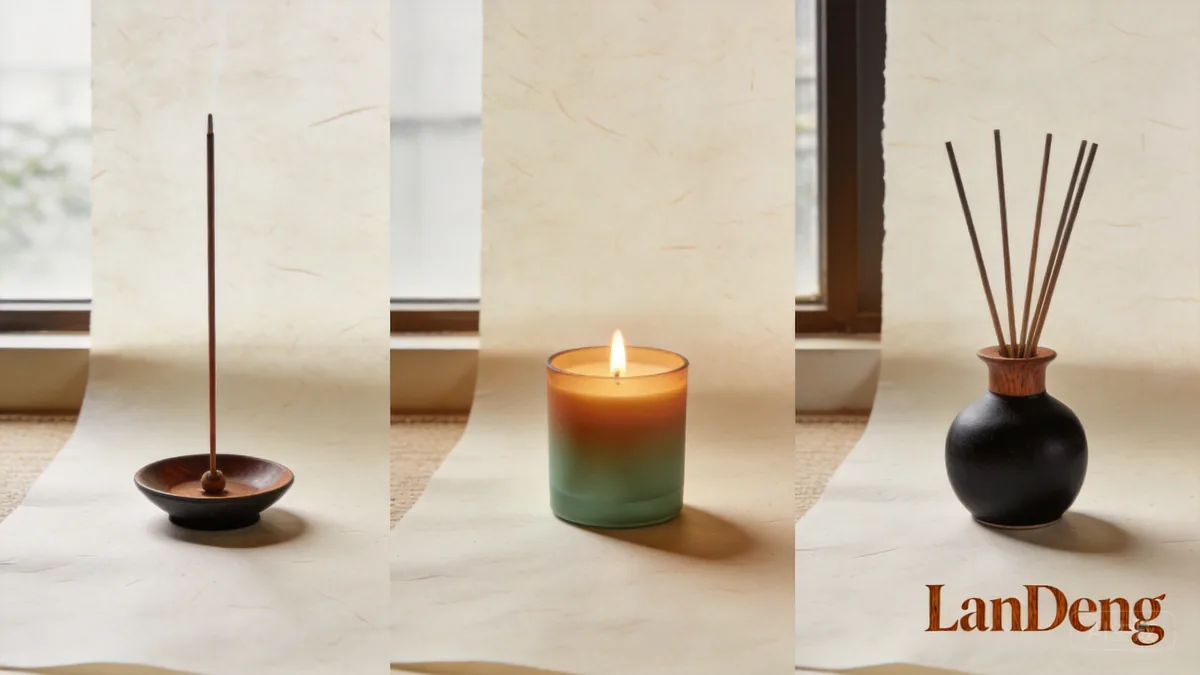
Technical answer: The three main ways to scent a room — incense, candles, and diffusers — differ by how they release scent: incense burns plant material, candles burn wax, and diffusers evaporate oil. The right one depends on whether you want smoke, flame, or neither.
Key facts: If you want a material, ritual scent with smoke, choose incense. If you want ambient light plus scent, choose a candle. If you want a clean, constant, flameless scent, choose a diffuser.
The Three at a Glance
| Incense | Candle | Diffuser (reed / ultrasonic) | |
|---|---|---|---|
| Releases scent by | Combustion | Burning wax | Evaporation |
| Smoke | Yes | Minimal (soot) | None |
| Flame | Ember | Open flame | None |
| Character | Material, ritual | Cozy, ambient | Clean, constant |
The Comparisons
- Incense vs essential oil diffuser — combustion vs vaporization.
- Incense sticks vs candles — material smoke vs wax soot, ember vs flame.
- Incense vs reed diffuser & wax melts — combustion vs evaporation vs warming.
- Which is better for a small room? — smoke concentration in small spaces.
- Chinese incense vs oils vs candles — the full material-vs-method picture.
The One-Question Decision
Ask yourself: do I want smoke?
- Yes → incense (the only one of the three that gives the material, smoky, ritual character).
- No, but I want flame/light → candle.
- No, and I want clean/constant → diffuser.
That single question resolves most of the choice. The rest is detail, covered in the comparisons above.
Common Mistakes
- Treating the three as interchangeable. They release different things in different ways.
- Assuming “no flame” means “no particles.” Candles produce soot; only diffusers avoid combustion entirely.
- Buying “the best” without saying “for what.” Each fits a different want.
The Author’s Take
Position: The one-question decision — “do I want smoke?” — is the whole subject in a sentence.
Reasoning:
- People usually already know the answer; they want permission to pick the candle or the diffuser without being told incense is “better.”
- They are three tools, not one winner — let the smoke question do the sorting.
This is the author’s editorial view and experience — not a verified fact.
Verification Notes
- Combustion (incense/candle) vs evaporation (diffuser) is a basic physical distinction.
- No health or medical claims are made.
FAQ
Q: What is the main difference between incense, candles, and diffusers?
A: The mechanism by which each releases scent. Incense burns plant material, producing smoke and a material, ritual character. Candles burn wax, producing ambient light plus scent, along with soot. Diffusers — reed or ultrasonic — evaporate or disperse oil into the air, giving a clean, constant, flameless scent with no combustion at all. The practical question that sorts them is whether you want smoke, flame, or neither: smoke and ritual point to incense, light plus scent to a candle, and clean and constant to a diffuser. Everything else is detail.
Q: Which is the cleanest option?
A: A diffuser, because it produces no combustion smoke or soot at all. An ultrasonic diffuser mists water and a little oil into the air, and a reed diffuser evaporates fragrance passively — neither burns anything, so neither adds combustion particles. Candles produce soot and fine particles from the burning wax, and incense produces smoke from burning plant material. So if clean air is your priority, a diffuser is the clear choice. “Clean” here refers to combustion byproducts, not to any air-purifying claim — none of the three removes pollutants or odors.
Q: Which gives the most “ritual” feel?
A: Incense. It is the only one of the three tied to a material, often cultural or ritual tradition — lighting a stick or warming resin is a deliberate act with a beginning and an end, and the smoke and ash are part of the experience. In many traditions incense marks the start of meditation, ceremony, or a wind-down, which gives it a weight the others don’t carry. A candle has its own quiet ritual in lighting the wick, and a diffuser is mostly set-and-forget, but for a felt sense of occasion, incense is the strongest. It is also the one with smoke, which is part of that character.
Q: Which is best?
A: It depends on what you want, because the three are different tools rather than one winner. Choose incense when you want smoke, a material scent, and a ritual feel. Choose a candle when you want ambient light plus scent together, or a cozy, decorative experience. Choose a diffuser when you want a clean, constant, flameless scent with no smoke and little effort. The single question that resolves most of it is whether you want smoke: yes means incense, no-but-want-light means candle, and no-and-want-clean means diffuser. Pick by that, not by marketing claims.
More Questions Answered
Q: Which of the three is best for a bedroom?
It depends on what you want at bedtime. A diffuser gives a clean, flameless, constant scent with no smoke, and it can run safely for a long stretch without supervision — the safest default for a bedroom. A candle gives light plus scent but has an open flame, so it should be extinguished before you sleep. Incense gives smoke and ritual but should always be put out before bed, and never left burning overnight. For a bedroom, the diffuser is usually the cleanest and lowest-risk choice; if you prefer a flame or smoke, finish the burn well before sleep. See incense safety.
Q: Do incense and candles both produce particles?
Yes. Both are combustion sources, and combustion always puts particles into the air. Incense produces visible smoke plus fine particles from burning plant material and binder. A candle produces soot and fine particles from the burning wax and wick, even when the flame looks clean. Neither is particle-free, and neither is “clean air.” Only a diffuser avoids combustion entirely — it disperses oil without burning anything, so it adds no combustion particles. Ventilate whichever you burn, and don’t assume a candle is smoke-free just because it produces less visible output. See incense sticks vs candles.
Q: Which is cheapest to run?
Incense is typically cheapest per use — a single stick can cost pennies — but each stick is fixed-duration, so you pay again each session. A candle runs for hours from one purchase, spreading the cost over many evenings, though quality candles vary widely in price. A diffuser has a higher upfront cost plus ongoing electricity and oil refills, and reed diffusers need replacement reeds and oil over time. So on a strict per-use basis incense usually wins, but on cost-per-hour a long-burning candle can be comparable. Pick by how you actually use them, not just the sticker price.
Q: Which produces the least waste?
It depends on what you count as waste. A diffuser, whether ultrasonic (water plus a little oil) or reed (glass bottle plus reeds), produces no ash and little ongoing waste, though it uses electricity and eventually needs oil refills and reed replacement. A candle leaves a glass jar, which can be cleaned and reused, and some wax melts come in recyclable clamshells. Incense leaves ash and, with bamboo-core sticks, a small burnt core. In terms of combustion particulate, an electric diffuser produces none at all, which is the cleaner choice for the air itself.
Q: Do any of the three remove odors rather than mask them?
None truly removes an odor — all three add scent over whatever is already in the air, rather than eliminating it. That is an important distinction: an air “freshener” or scented candle covers a smell; it does not filter or neutralize it. Some ultrasonic diffusers are marketed with cleaning claims, but dispersing fragrance is not the same as removing odor or particles. The honest way to actually clear a smell is ventilation — an open window, an exhaust fan, or real air exchange. Treat incense, candles, and diffusers as ways to add a scent, not to clean the air.
Q: Which is easiest to set up for a beginner?
A diffuser is the most plug-and-play. An ultrasonic diffuser needs only water, a few drops of oil, and a power outlet, then it runs with a press of a button — no flame, no ash, little to watch. A reed diffuser is even simpler: set the reeds in the oil and let it sit. Incense needs a holder and a heatproof, stable surface, and you must light it and manage the ash. A candle needs a stable, draft-free spot and a holder that contains the flame. For someone who wants the least effort and the least to remember, the diffuser is the gentlest starting point.
Q: Which is best for a small bathroom?
A quick cone or a small diffuser. A bathroom is small and often poorly ventilated, so a large stick or a full-size candle overwhelms the space fast, leaving it smoky or cloying. A short-burning cone gives a brief scent that clears quickly, and a small diffuser gives a light, constant scent with no smoke — the cleaner choice for a tight room. Whichever you pick, run the exhaust fan or open a door so the scent and any smoke don’t linger. Match the intensity to the room: in a small space, less is more.
Sources
- EPA indoor air quality — combustion particulate matter (PM2.5) is the basis of the smoke-comparison framing.
- American Lung Association — indoor air pollutants — background on combustion particles from incense and candles.
- Editorial synthesis of usage differences; no therapeutic claims.
Related Resources
- Incense vs Essential Oil Diffuser
- Incense Sticks vs Candles
- Chinese Incense vs Essential Oils vs Candles
Natural next step: start with the cleanest comparison in incense vs essential oil diffuser, or the flame question in incense sticks vs candles.