Technical answer: 花蕊夫人衙香 is a rich court 合香 attributed to 花蕊夫人 (Lady Huarui), the famous consort of the Later Shu ruler 孟昶. It is built on the classic court trio — agarwood, sandalwood, and musk — with frankincense, borneol, and ambergris-derived 甲香 for depth.
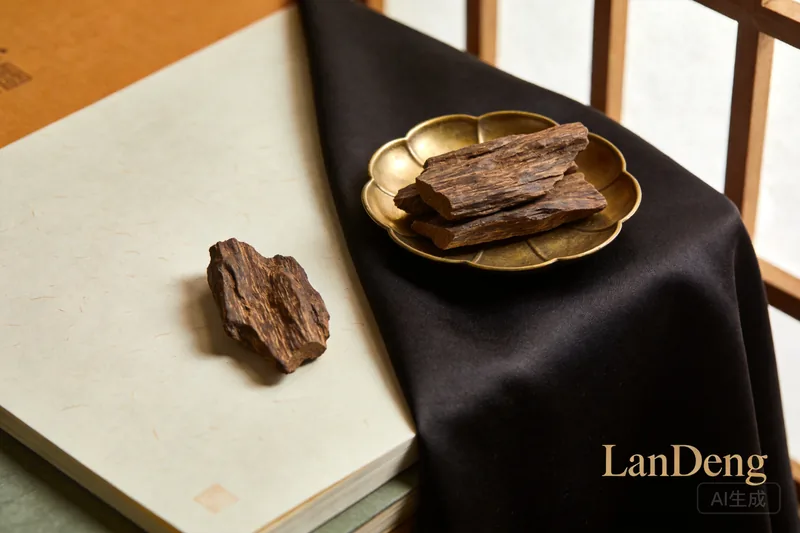
Key facts: 衙香 (yamen incense) was a category of court/office incense, not a single scent — and the 花蕊夫人 version is the most famous named one. It is a lesson in the rich, layered court blend as distinct from the leaner scholar blends.
The Recipe (香乘 version)
沉香三两、栈香三两、檀香一两、乳香一两、龙脑半钱、甲香一两、麝香一钱 — three liǎng agarwood (沉香), three liǎng 栈香 (a non-sinking agarwood grade), one liǎng sandalwood (檀香), one liǎng frankincense (乳香), half a qián borneol (龙脑), one liǎng 甲香 (operculum), and one qián musk (麝香). Except the borneol, grind together; add 炭皮末 (charcoal-bark powder) and 朴硝 (saltpetre) one qián each; blend with raw honey; warm in a sealed vessel over boiling water (重汤) ten or so times; age (窨) seven days; form into cakes and burn.
| Role | Ingredient | Job in the blend |
|---|---|---|
| 君 (chief) | 沉香 + 栈香 agarwood (two grades) | The deep resinous backbone |
| 臣 (minister) | 檀香 + 乳香 sandalwood, frankincense | Warm wood and bright resin support |
| 佐 (assistant) | 龙脑 borneol | A cool, crystalline lift that brightens the heavy base |
| 使 (guide) | 甲香 + 麝香 + 炭皮末/朴硝 + honey | Fixatives, combustion aids, and binder |
Proportions and Unit Conversion
The recorded proportions (香乘):
| Ingredient | Quantity |
|---|---|
| 沉香 (agarwood) | 三两 (3 liǎng) |
| 栈香 (non-sinking agarwood grade) | 三两 (3 liǎng) |
| 檀香 (sandalwood) | 一两 (1 liǎng) |
| 乳香 (frankincense) | 一两 (1 liǎng) |
| 龙脑 (borneol) | 半钱 (0.5 qián) |
| 甲香 (operculum) | 一两 (1 liǎng, 法制 treated) |
| 麝香 (musk) | 一钱 (1 qián) |
| 炭皮末 (charcoal-bark powder) | 一钱 (1 qián) |
| 朴硝 (saltpetre) | 一钱 (1 qián) |
The ratio shows the court blend’s structure: the two agarwood grades together form the dominant body (six liǎng combined), with sandalwood, frankincense, and operculum each at one liǎng as the support, and borneol, musk, and the two combustion aids as the small accents measured in qián.
Unit conversion: one 两 (liǎng) was on the order of 37 g in the Song–Ming period — the exact gram value varied by dynasty, roughly 31–41 g across periods — divided into 10 钱 (qián) of about 3.7 g each, each 钱 into 10 分 (fēn) of about 0.37 g. Read the ratios, not the grams: the core here is a 3:3:1:1 agarwood-to-sandalwood-to-frankincense-to-operculum balance, with the precious accents (borneol, musk) at a tenth of a liǎng or less.
What “衙香” Means
衙香 is not one recipe — it is a class of compound incense used in the yamen (官署, official offices) and court. The 陈氏香谱 alone lists fifteen 衙香 recipes. The common thread: the 沉檀麝 trio (agarwood, sandalwood, musk) at the core, meaning these were expensive, courtly blends — the opposite of the humble 柏子香.
The Honest Caveats
- The 花蕊夫人 attribution is traditional, not a signed document.
- The historical 两/钱 weights varied — read the ratios, not the grams.
- 甲香 is operculum (a shellfish-derived material), a traditional fixative rarely used today; modern reproductions typically substitute or omit it.
The Author’s Take
Position: 花蕊夫人衙香 is the “rich blend” that shows 合香 was not always austere — the court could layer agarwood, sandalwood, musk, and borneol into something deliberately opulent.
Reasoning:
- The 沉檀麝 core marks it as a status blend — the materials themselves signal wealth.
- Contrast it with 柏子香 (a humble seed) and the full social range of the tradition becomes visible.
This is the author’s editorial view and experience — not a verified fact.
Verification Notes
- The formula is drawn from 香乘 (Xiang Cheng) via ctext.org and 识典古籍.
- Attribution is flagged as traditional; no therapeutic claim is made.
See Chinese Incense Recipes (香方): Translated from the Classical Manuals for the full guide.
FAQ
Q: What is 花蕊夫人衙香?
A rich court compound incense (合香) attributed to Lady Huarui, built on the classic agarwood–sandalwood–musk core with frankincense, borneol, and operculum (甲香) for depth. It is the most famous named example of the 衙香 category, and its proportions — six liǎng of the two agarwood grades combined against one-liǎng support materials — mark it as an opulent status blend rather than a leaner scholar incense. The attribution to Lady Huarui is traditional and widely repeated, not a signed historical document, so the page treats the identity as a label rather than verified authorship.
Q: What is 衙香?
衙香 (yamen incense) is a category of court and official-office compound incense, not a single fixed scent. The name comes from the yamen, or government office, where such incense was burned. The 陈氏香谱 alone lists fifteen distinct 衙香 recipes, all sharing the same agarwood–sandalwood–musk core. The common thread is expense: these were courtly blends made from costly materials, the opposite of a humble seed-based incense like 柏子香. So the label tells you about the blend’s social register and material profile, not one specific fragrance.
Q: What is 甲香?
甲香 is operculum — the hard, shell-like disc that seals the opening of certain sea snails. In classical incense it was used as a fixative to bind and stabilize a blend’s scent, and the 香乘 versions of this recipe call for it to be treated (法制) before use. It is rarely used in modern reproduction: the material is uncommon and often replaced or omitted, and its animal origin makes it unsuitable for vegetarian or cruelty-conscious makers. When it appears in old formulas, read it as a functional fixative from the shellfish tradition, not a fragrance note in its own right.
Q: Who was 花蕊夫人?
花蕊夫人 (Lady Huarui) was the celebrated consort of 孟昶 (Meng Chang), ruler of the Later Shu kingdom in the tenth century. She is remembered as a poet and a beauty, and several poems are attributed to her — most famously lines lamenting the fall of the kingdom. The incense recipe that carries her name is part of that romantic legend: a courtly, luxurious blend named for a glamorous figure of the period. The attribution is traditional rather than verifiable, so the page presents her as the legendary namesake of the recipe, not its documented author.
Sources
- 香乘 (Xiang Cheng), 周嘉胄 (Ming) — the 花蕊夫人衙香 formula. Full text on Wikisource.
- 陈氏香谱 — the 衙香 category (fifteen recipes).
- 本草綱目 — the materia medica documenting the formula’s materials (agarwood, sandalwood, frankincense, borneol, musk). Full text on ctext.org.
Related Resources
Natural next step: see the humble counterpoint in 柏子香 (cypress-seed incense).