Key takeaway: Agarwood (沉香 chénxiāng) is graded primarily by resin density — expressed in the 沉水 (sink-in-water) system — and by the 奇楠 (qínán) distinction, which separates the top “oil-wraps-wood” grade from ordinary “wood-wraps-oil” agarwood. The five-color 奇楠 hierarchy (白/绿/紫/黄/黑) is a further, traditional subdivision.
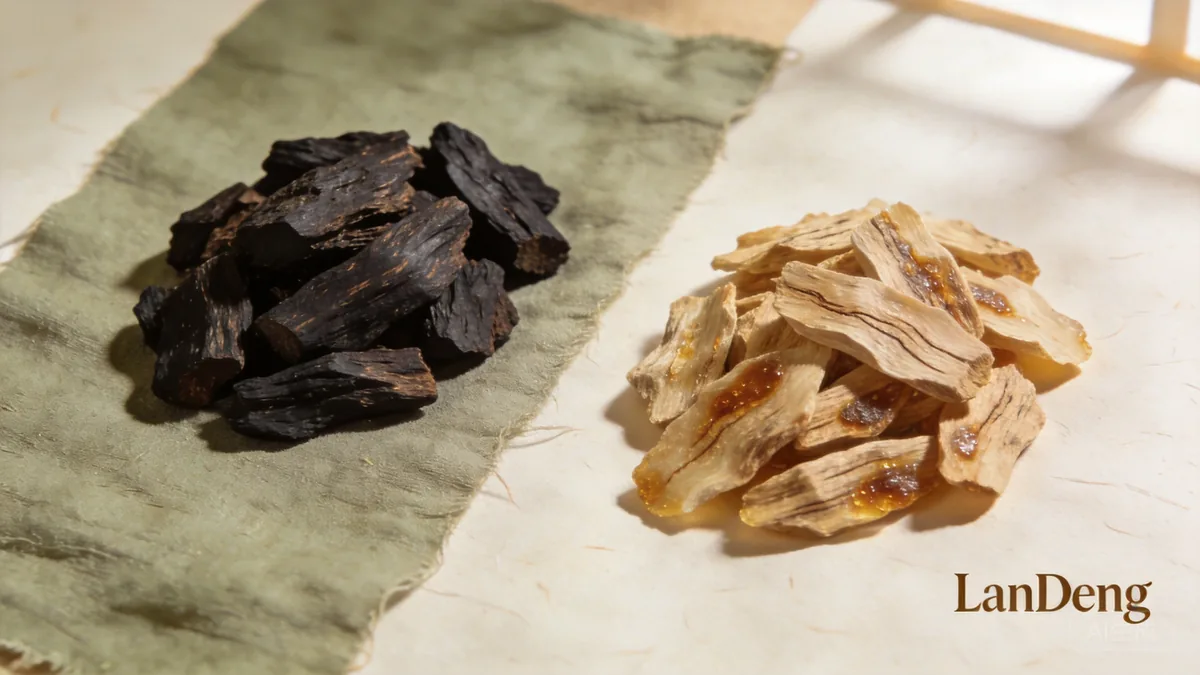
Key facts: This is the deep grading reference; for the broader “what is agarwood” and aroma material, see the agarwood scent guide.
Key Takeaways
- 沉香 = “sinking fragrance” — the name encodes the primary grading method.
- The 沉水 system grades by whether the material sinks, half-sinks, or floats in water.
- 奇楠 (qínán / “kyara”) is the top grade, distinguished by “oil wraps wood” vs ordinary 沉香’s “wood wraps oil.”
- The five-color 奇楠 hierarchy (white/green/purple/yellow/black) is traditional — and sources disagree on whether some colors are distinct grades or aging stages.
- The etymology of 奇楠 is genuinely uncertain; this page does not assert a single origin.
The 沉水 (Sinking) System
The name 沉香 literally means “sinking fragrance,” and the primary grading method is physical: does the piece sink in water?
| Grade | Behavior | Resin content |
|---|---|---|
| 沉水 (sinks) | Fully submerged | Highest, most valuable |
| 半沉半浮 (half-sinks) | Partially submerged | Medium |
| 浮 (floats) | Floats | Lower (historically 黄熟香) |
The logic is direct: resin is denser than wood, so the most resin-saturated pieces sink. This is the backbone of the Chinese grading system — and it is surprisingly rarely explained clearly in English.
奇楠 vs. Ordinary Agarwood (the Distinction English Misses)
The single most important grading distinction is between ordinary 沉香 and the top grade, 奇楠 (qínán, Japanese “kyara”):
- Ordinary 沉香 = “wood wraps oil” (木包油). Hard wood with resin veins running through it.
- 奇楠 = “oil wraps wood” (油包木). The wood fiber is so thoroughly resin-transformed that the material becomes soft and pliable — it “shaves into curls and kneads into pellets” (削之成卷、捏之成丸) and is aromatic even at room temperature.
This is not a small difference; it is a different material state. The traditional description is worth learning because it is the one piece of the system English content almost always omits.
The Five-Color 奇楠 Hierarchy (Traditional)
奇楠 is further divided by color, traditionally into five grades:
| Color | Chinese | Notes |
|---|---|---|
| 白 (white) | 白奇楠 | Highest |
| 绿 (green) | 绿奇楠 / 莺歌绿 | Widely regarded top tier |
| 紫 (purple) | 紫奇楠 / 兰花结 | Disputed — distinct grade or aging stage? |
| 黄 (yellow) | 黄奇楠 / 金丝结 | Disputed — distinct grade or aging stage? |
| 黑 (black) | 黑奇楠 / 铁结 | Lower |
Important caveat: sources disagree on whether the purple and yellow grades are distinct grades or aging stages of the green grade. This page treats the hierarchy as traditional and possibly non-distinct, rather than settled fact.
Formation Types
How the resin formed also factors into grading and naming:
- 熟结 — resin from a dead tree, buried or aged.
- 生结 — resin from a living tree.
- 虫漏 — resin formed around insect boring.
- 脱落 — resin from an external wound or break.
These describe how the agarwood came to be, and interact with the density and 奇楠 distinctions above.
Price Signals: How Much Should It Cost?
Price is the grading system’s shadow — the 沉水 and 奇楠 tiers exist partly because they command wildly different prices. The honest summary, in rough, market-dependent terms:
| Material / grade | Rough price signal (RMB, varies by origin & market) |
|---|---|
| Ordinary agarwood (中药铺 medicinal-grade chips) | ~0.4–1.4 RMB per gram — a cheap herb, not a treasure |
| Burnable / gradeable agarwood (可品沉香) | tens to thousands of RMB per gram, scaling with resin density |
| 沉水 (sinking) agarwood | a steep premium over floating grades of the same piece |
| 奇楠 (qínán / “kyara”) | ~3,000–8,000 RMB per gram at wholesale; top white 奇楠 can exceed 16,000 RMB/g |
| India “old mountain” sandalwood (老山檀) | ~10–150 RMB per gram, by age and density |
| Plantation sandalwood (澳洲/印尼) | well under ~3 RMB per gram |
The single most useful price insight: the saying “沉香贵过黄金” (“agarwood is more valuable than gold”) is misleading as usually repeated. Ordinary medicinal agarwood is cheap — a few RMB per gram. It is only the top grades (dense 沉水, and above all 奇楠) that reach gold-scale prices. When a seller prices every piece as if it were 奇楠, that is the strongest signal to walk away.
These figures are directional market signals, not a price list — prices are volatile, grade-dependent, and the market is famously full of fakes (see the authentication database).
Etymology: An Honest “Uncertain”
The origin of the name 奇楠 is genuinely disputed. Theories include:
- Sanskrit Kāla (काल, “black/time”).
- Sanskrit tagara, “a fragrant plant,” shortened to 伽罗/伽楠.
- A “temple” (伽蓝) reading.
More rigorous 考证 argues that tagara is a mistranslation — the Sanskrit word for agarwood is agaru / aguru, not tagara.
The honest position: “etymology uncertain; multiple theories.” This page does not pick one.
Grading Beyond the Sink Test: What Else Matters
The 沉水 sink test is the headline, but it is not the whole system. In practice, grading weighs several factors at once:
- Resin density — the core axis, measured by the sink/float test and by visible oil content.
- Oil content and distribution — how much resin, and whether it runs in veins (木包油) or saturates the fiber (油包木).
- Aroma — the most consequential factor in practice: does it smell complex and sweet on gentle heat, and does it develop in stages (头香/本香/尾香)?
- Formation type — 熟结 / 生结 / 虫漏 / 脱落 carry different reputations and prices.
- Origin — a Hainan or Vietnamese piece and a plantation piece can carry very different prices for similar density.
The honest summary: density is the most objective axis, but aroma is what buyers ultimately pay for. A dense but dull-smelling piece is not automatically worth more than a lighter but vivid one — which is why grading is partly measurement and partly tasting. In that sense agarwood grading resembles tea or wine grading: there is a measurable backbone, but the final judgment is sensory and, at the top end, unavoidably subjective.
A Genuine Wrinkle: 奇楠 and the Sink Test
There is a documented tension in the traditional system worth knowing, because English content almost never mentions it. The “sinking = best” rule holds for ordinary 沉香, but some sources hold that top 奇楠 is often 半沉半浮 (half-sinking), not fully 沉水 — because its resin is soft and evenly distributed through the fiber rather than densely concentrated. A piece of 奇楠 can be superlative in aroma while not fully sinking.
This is a real distinction, not a rounding error: the sink test grades resin concentration, while 奇楠 grades resin transformation. The two are related but not the same. Treat “it must sink” as a rule of thumb for ordinary agarwood, not as an absolute for 奇楠.
How Grading Interacts with Authentication
Grading and authentication are entangled, because fakes are engineered to pass the grading signals:
- Oil-injection and oil-boiling add weight so treated wood sinks — defeating the sink test.
- Dye-soaking darkens the wood to mimic resin density.
- Synthetic fragrance mimics the aroma, at least on first sniff.
This is why a grading label alone (“沉水”, “奇楠”) is a claim, not a proof. The label tells you what the seller asserts; authentication tells you whether the material backs it up. See the authentication database and the substitution cross-reference.
Grading Vocabulary Across Traditions
Different traditions grade the same material with different vocabularies. Knowing they overlap helps you read across sources:
| Tradition | System | What it grades |
|---|---|---|
| Chinese | 沉水 (sink/half-sink/float) + 奇楠 color grades | Resin density and the 奇楠 distinction |
| Japanese | rikkoku gomi (六国五味) | Six “countries,” five “tastes” — a classical descriptive framework |
| Vietnamese | regional/origin grades (e.g., Nha Trang) | Origin and aroma reputation |
The Japanese rikkoku gomi “countries” are traditional labels, not verified modern geography — much like the Chinese 奇楠 color hierarchy is traditional rather than settled taxonomy. Neither should be read as a modern provenance certificate. For the Japanese side, see kōdō.
Reading a Seller’s Grading Claims
When a seller grades a piece, translate the label into questions:
- “Sinking” — verified how? Ask whether it was actually tested, and remember oil-injection fakes sink too.
- “奇楠” — on what basis? The soft, pliable, room-temperature-aromatic character, or just a price tag?
- Origin — named? A specific origin is more informative than “premium agarwood.”
- Price vs. grade — consistent? A 奇楠 label at ordinary-agarwood prices is a contradiction to resolve.
The label is a starting point for questions, not an ending point for trust.
A Grading Sequence: How to Walk Through a Piece
When you encounter a piece of agarwood, the grading factors above can be applied in a rough order:
- Sink test — does it sink, half-sink, or float? This gives a first read on resin concentration, with the 奇楠 caveat noted above.
- Look at the resin — is the oil in veins through hard wood (ordinary 沉香) or saturating soft, pliable fiber (奇楠)?
- Smell it warm — on gentle heat, is the aroma complex and sweet, and does it open in stages? Aroma is the practical tiebreaker.
- Note the formation type — 熟结, 生结, 虫漏, or 脱落 — and the claimed origin.
- Check the price against the grade — does the label, the material, and the price all tell the same story?
The sequence matters because it keeps the objective test (density) first and the subjective test (aroma) decisive, without letting either one alone carry the judgment. It also makes clear where the fakes attack: at the sink test, at the color, and at the price-to-grade consistency.
The Author’s Take
Position: The 沉水 sink test is at once the most useful and the most overrated grading signal in agarwood — because oil-injection fakes are engineered specifically to sink.
Reasoning:
- Useful: it is objective — the piece either sinks or it does not, no argument.
- Overrated: fakes are built to pass it, so the test grades the counterfeiter’s technique, not the wood.
- A better first question is “how does it smell when gently heated, and who is selling it to me?”
This is the author’s editorial view and experience — not a verified fact.
Verification Notes
- The 沉水 system and the “oil-wraps-wood vs wood-wraps-oil” 奇楠 distinction are drawn from Chinese specialist sources and are traditional grading frameworks, not laboratory standards.
- The five-color hierarchy is marked as traditional and possibly non-distinct where sources conflict.
- The 奇楠 etymology is explicitly marked uncertain.
- No therapeutic or medical claims are made.
Related data asset: the material comparison matrix places agarwood against its substitutes and complements. See The Complete Incense Scent Guide: Choosing a Scent by Atmosphere for the full guide.
FAQ
Q: What is the difference between 沉香 and 奇楠?
Ordinary 沉香 is “wood wraps oil” (木包油): hard wood with resin veins running through it. 奇楠 is “oil wraps wood” (油包木): the wood fiber is so thoroughly resin-transformed that the material becomes soft and pliable — the traditional description is that it shaves into curls and kneads into pellets — and it is aromatic even at room temperature. 奇楠 is the top grade. A further, practical distinction is that the sink test is a reliable signal for ordinary 沉香, but top 奇楠 is sometimes described as half-sinking rather than fully sinking, because its resin is soft and evenly distributed rather than densely concentrated.
Q: How is agarwood graded?
Primarily by resin density via the 沉水 (sink-in-water) system — sinking is highest, half-sinking is medium, floating is lower — then by the 奇楠 distinction that separates “oil-wraps-wood” from ordinary “wood-wraps-oil” material, then (traditionally) by the five-color 奇楠 hierarchy. In practice grading also weighs oil content and distribution, aroma on gentle heat, formation type (熟结/生结/虫漏/脱落), and origin. Density is the most objective axis; aroma is what buyers ultimately pay for. No single test is authoritative, and the sink test in particular is weakened by oil-injection fakes built to sink.
Q: What does “sinking fragrance” mean?
沉香 literally means “sinking fragrance” — the name encodes the primary grading method. Resin is denser than wood, so the most resin-saturated pieces are dense enough to sink in water, while less-resinous wood floats. The finest pieces sink, which is why “sinking” became the mark of quality. This physical test is the backbone of the classical Chinese grading system, but it grades resin concentration, not aroma or the 奇楠 transformation — so it is a useful rule of thumb rather than a complete judgment of quality.
Q: Is the five-color 奇楠 hierarchy settled?
No — sources disagree on whether the purple (紫) and yellow (黄) grades are distinct grades or aging stages of the green (绿) grade. The hierarchy itself — white (白), green (绿), purple (紫), yellow (黄), black (黑) 奇楠 — is a traditional subdivision, not a laboratory taxonomy. This page treats it as traditional and possibly non-distinct rather than settled fact. When a seller leans hard on a specific color grade as a pricing justification, ask what the color is actually claimed to indicate, and whether it is anything more than a naming convention.
Q: Where does the word 奇楠 come from?
It is genuinely uncertain — competing theories include Sanskrit “Kāla” (black/time), Sanskrit “tagara” (a fragrant plant, shortened to 伽罗/伽楠), and a “temple” (伽蓝) reading. More rigorous scholarship argues that “tagara” is a mistranslation and that the Sanskrit word for agarwood is “agaru/aguru,” not tagara. The honest position is “etymology uncertain; multiple theories” — this page does not pick one. The Japanese term “kyara” (伽罗) is the cognate and carries the same ambiguity about ultimate origin.
Sources
- 周嘉胄《香乘》(Ming) — 沉香/奇楠 grades and the 沉水 system. Full text on Wikisource.
- 本草纲目 — historical materia-medica record; 沉香/奇楠 entries are traditional language, not clinical evidence. Full text on Wikisource.
- Flora of China — Aquilaria genus entry (botanical identity).
- Naef, R. — The volatile and semi-volatile constituents of agarwood (review). DOI.
- Chinese specialist and consumer sources on 奇楠 grading and authentication (consumer/specialist tier; some conflict on the five-color hierarchy, flagged in the text).
- Research synthesis: docs/research/agarwood-chenxiang-notes.md (R-001).
Related Resources
Natural next step: see how fakes exploit this grading system in the authentication database, or the scent-level view in the agarwood guide.